
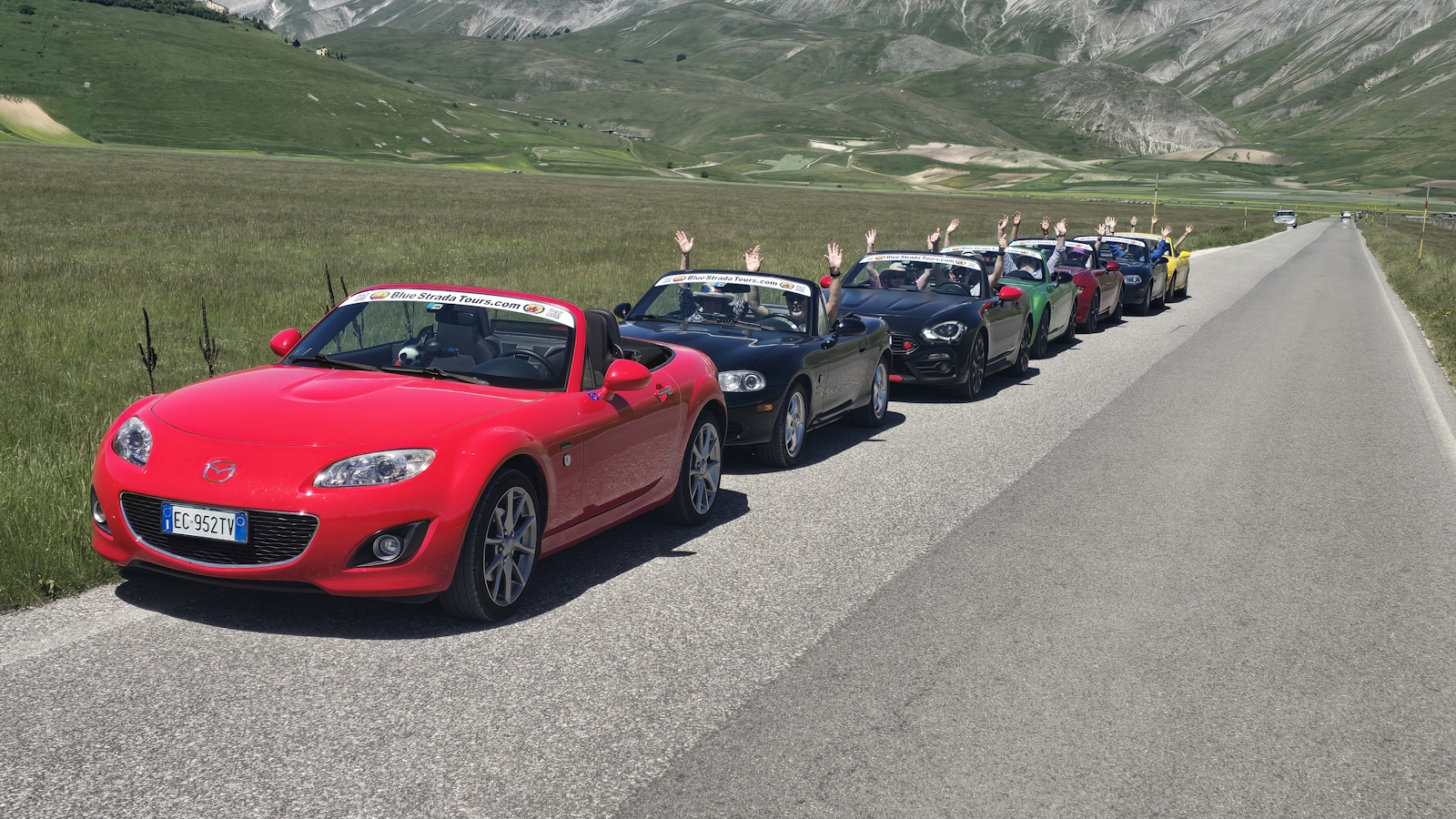
Most people who book a guided driving tour for the first time arrive with the same set of expectations: good roads, decent hotels, and a group that probably moves a little slower than they’d like. They’re pleasantly surprised on all three counts. What genuinely catches them off guard is everything they didn’t think to expect — the restaurant in an Umbrian abbey, the winery in the Chianti hills that doesn’t advertise, the roadside café where the espresso is better than anything they’ve had in a city.

Blue Strada tours are guided by someone who was born and raised in Italy, has been driving its roads for decades, and applies the same local knowledge to every aspect of the experience — not just the route. The roads nobody outside Italy knows about and the restaurants no guidebook lists are found the same way: by someone who grew up here and never stopped paying attention.

Here’s how it all works — the group format, the daily rhythm, and what makes these tours different from the standard convoy drive.

The Problem with Most Group Drives

The standard convoy model has a fundamental tension built into it: the pace is set by the leader, and the leader has to set a pace that works for everyone. That means the faster drivers are always waiting and the slower drivers are always anxious. Nobody is actually driving the road — they’re managing their position in a chain.

Larger groups make it worse. Get more than eight or ten cars in a line and the accordion effect takes over — small gaps at the front become large ones at the back, and the rear cars end up stopping and sprinting just to keep up. It’s less of a drive and more of an exercise in frustration management.

This is the group drive that most enthusiasts have experienced. It’s not what Blue Strada does.

Two Groups, Two Experiences

When numbers allow, the tour splits into two groups. Claudio calls them the fast group and the daisy pickers — the latter said with genuine affection. I tend to use the sport group and touring group, terms that better describe what each group is actually there to do. Either way, you choose which suits you on any given day, and you can switch based on your mood or who has the wheel.

It’s worth noting that the split isn’t always about driving ability. Sometimes a spouse or partner prefers a more relaxed pace, and a car ends up in the touring group for reasons that have nothing to do with the driver’s capabilities. The format accommodates that without anyone having to compromise their day.

Neither group has more than six cars including the leader — small enough that the group moves as a unit rather than a chain. Both groups cover the same route, stop at the same places, and eat at the same table at the end of the day. The touring group arrives a few minutes behind, and may linger a little longer at a viewpoint that earns it. That’s the extent of the difference on the road.

The Sport Group — Closer to a Motorcycle Tour

Claudio leads the sport group, and this is where most enthusiasts’ expectations get adjusted. What surprises first-time guests is how committed the pace actually is. Claudio is an exceptionally accomplished driver, and on the right road he makes full use of that. These are not leisurely drives with occasional spirited corners — on roads like the SS125 in Sardinia or the mountain passes above Siena, the pace is something most guests describe, afterward, as closer to a motorcycle tour than any car group drive they’ve been on.

That’s not an accident. Blue Strada grew out of motorcycle touring, and the philosophy carried over: small groups, a guide who knows every corner intimately, and a pace that respects what the drivers and cars are actually capable of.

First-time guests who arrive most skeptical about group driving are usually the ones who gush about it afterward. They expected to be held back. What they got was something else entirely.

What they got was access to roads they couldn’t have driven as confidently alone — because nobody knows the SS125 the way Claudio does, and that knowledge translates directly into how fast you can safely use it.

The Radio Advantage

Radios are provided to everyone in the group, and they serve two purposes. The first is navigation — Claudio calls out turns, conditions, and anything worth knowing ahead. The second is that the group can communicate back: ask a question, request a stop, flag something. Nobody is ever stuck wondering what’s happening or anxious about falling behind.

On canyon roads like Sardinia’s SS125, where limited sight distances make passing slow-moving traffic a genuine challenge, the radio becomes something more. Claudio passes a campervan, calls back when the road is clear, and each car follows in turn — cleanly, safely, knowing exactly what’s coming. Without that, you might spend 20 minutes trapped behind a slow vehicle with no safe way past. With it, it’s a 90-second problem. The difference on a road like the SS125 is considerable.

Running Order Matters

Something most touring companies don’t bother with — and Blue Strada does — is optimizing the running order within the group. By day two or three, Claudio has a feel for how each driver moves and adjusts accordingly. The result is that the car in front of you is not slower than you want to go, and the car behind you is not faster. The group flows rather than concertinas.

It takes a couple of days to dial in. By midweek, it’s right.

The Touring Group Is Not Second Class

The daisy pickers drive the same roads, stop at the same places, eat the same meals, and stay at the same properties. The difference is pace and temperament — a few minutes behind, and perhaps a little more time at a viewpoint worth the stop. Both groups have a genuinely good day, and both arrive at dinner with stories.

And for those in the touring group who want to settle competitive questions off public roads — both the Tuscany and Sardinia tours include a go-kart event. The daisy pickers have been known to have the last word there.

How a Typical Day Runs

For anyone trying to visualize what a Blue Strada tour day actually looks like — and for partners or spouses trying to gauge how much of the day is spent in the car — here’s the rhythm that most days follow. Specific stops vary by tour and by day, but the structure is consistent.

A Day on Tour

~9:00 AM
Depart from the overnight location. Both groups head out, sport group typically first. Morning driving is often the best — light traffic, cool air, the roads largely to yourselves.
Mid-morning
Coffee and restroom stop — at a café, or occasionally a destination worth a look in its own right. A note on Italian gas station coffee: it is genuinely excellent. This is not a consolation; it is a fact.
~12:00 PM
Midday stop — both groups together. Lunch is leisurely, an hour or more. On Tuscany days especially, the midday stop is often a town or village worth walking. The cars park; the afternoon is on foot.
Early afternoon
Coffee stop before the afternoon driving section. The afternoon roads often have the best light — and with the destination close, there’s nothing to hurry for.
4:00–5:00 PM
Arrive at the next overnight location. Check in, decompress, get ready for dinner. The evenings are unhurried by design. Dinner is included and it is not rushed either.

The structure means time in the car is well-paced — broken into manageable segments with genuine stops in between. Partners who don’t want long uninterrupted stretches in the car are accommodated by design, not as an afterthought. The radios help with this too: anyone can call a stop if they need one.

More Than a Driving Tour — The Food, the Wine, the Places

Ask guests what surprised them most about a Blue Strada tour and the answer is rarely the roads. The roads are extraordinary, but they expected that. What they didn’t expect was the food, the wine, and the properties — places that no guidebook lists and that no amount of research would surface without someone who knows where to look.

Guests who came for the driving describe these tours, afterward, as foodie tours with driving added in. The same local knowledge that finds the roads finds the agriturismo outside Siena that makes people reconsider their entire relationship with pasta, the winery in the Chianti hills worth the detour, the dinner in the Piazza del Campo that doesn’t appear on any tourist list. Properties like the Abbazia Collemedio — a restored medieval abbey in Umbria — and Podere La Strega outside Siena are the result of years of a local guide knowing which doors to open.

The balance between driving and destinations varies by tour:

Tuscany & Umbria is the most hybrid — multiple days with significant time on foot. Assisi and the Basilica (UNESCO), San Gimignano’s medieval towers, a wine tasting at a renowned Chianti winery, a guided tour of Siena and its Cathedral, dinner in the Piazza del Campo, the roofless medieval Abbey of San Galgano. The driving connects these places; the places are the point as much as the driving is.

Sardinia leans more driving-centric — the SS125, the canyon roads, the full island crossing — but the stops are no less carefully chosen. Dinner on the ancient ramparts of Alghero, a 3,500-year-old Nuraghe UNESCO site, and two days based near the Gorropu canyon give the tour a cultural layer the roads alone don’t provide.

Portugal is close to Tuscany in balance — the Peneda/Gerês National Park, the dramatic Picos de Europa, the Hermida Canyon, the Covadonga Sanctuary, the Basque Country, and a farewell dinner in Bilbao. Outstanding driving, equally considered destinations.

The Italian & Swiss Alps is the most driving-focused tour in the fleet — four Italian passes including the Stelvio at 2,760 meters, four Swiss passes including St. Gotthard, and a free day in Andermatt. Those who want the maximum concentration of mountain passes with minimal time in towns have found their tour. The food and accommodation are still Blue Strada standard — the balance just tilts further toward the road.

Blue Strada’s motorcycle tours share the same philosophy on food, lodging, and local knowledge — the balance shifts slightly further toward driving, reflecting a demographic that often prioritizes miles of road over hours on foot. The foundation is the same.

What It Feels Like from the Inside

Wayne Wilson drove Blue Strada tours for several years as a paying guest before joining the company as IT and E-Marketing Manager. His take: “Having someone who knows every corner lead you through means you concentrate entirely on driving. No GPS checking. No navigation anxiety. Just the road. And then you sit down to dinner and realize the driving was only half of it.”

Find Your Tour

Every Blue Strada Miata tour runs with the same format, the same local knowledge, and the same standard of food and accommodation. The roads are different. The experience is the same.

Most people who book a guided driving tour for the first time arrive with the same set of expectations: good roads, decent hotels, and a group that probably moves a little slower than they’d like. They’re pleasantly surprised on all three counts. What genuinely catches them off guard is everything they didn’t think to expect — the restaurant in an Umbrian abbey, the winery in the Chianti hills that doesn’t advertise, the roadside café where the espresso is better than anything they’ve had in a city.

Blue Strada tours are guided by someone who was born and raised in Italy, has been driving its roads for decades, and applies the same local knowledge to every aspect of the experience — not just the route. The roads nobody outside Italy knows about and the restaurants no guidebook lists are found the same way: by someone who grew up here and never stopped paying attention.

Here’s how it all works — the group format, the daily rhythm, and what makes these tours different from the standard convoy drive.

The Problem with Most Group Drives

The standard convoy model has a fundamental tension built into it: the pace is set by the leader, and the leader has to set a pace that works for everyone. That means the faster drivers are always waiting and the slower drivers are always anxious. Nobody is actually driving the road — they’re managing their position in a chain.

Larger groups make it worse. Get more than eight or ten cars in a line and the accordion effect takes over — small gaps at the front become large ones at the back, and the rear cars end up stopping and sprinting just to keep up. It’s less of a drive and more of an exercise in frustration management.

This is the group drive that most enthusiasts have experienced. It’s not what Blue Strada does.

Two Groups, Two Experiences

When numbers allow, the tour splits into two groups. Claudio calls them the fast group and the daisy pickers — the latter said with genuine affection. I tend to use the sport group and touring group, terms that better describe what each group is actually there to do. Either way, you choose which suits you on any given day, and you can switch based on your mood or who has the wheel.

It’s worth noting that the split isn’t always about driving ability. Sometimes a spouse or partner prefers a more relaxed pace, and a car ends up in the touring group for reasons that have nothing to do with the driver’s capabilities. The format accommodates that without anyone having to compromise their day.

Neither group has more than six cars including the leader — small enough that the group moves as a unit rather than a chain. Both groups cover the same route, stop at the same places, and eat at the same table at the end of the day. The touring group arrives a few minutes behind, and may linger a little longer at a viewpoint that earns it. That’s the extent of the difference on the road.

The Sport Group — Closer to a Motorcycle Tour

Claudio leads the sport group, and this is where most enthusiasts’ expectations get adjusted. What surprises first-time guests is how committed the pace actually is. Claudio is an exceptionally accomplished driver, and on the right road he makes full use of that. These are not leisurely drives with occasional spirited corners — on roads like the SS125 in Sardinia or the mountain passes above Siena, the pace is something most guests describe, afterward, as closer to a motorcycle tour than any car group drive they’ve been on.

That’s not an accident. Blue Strada grew out of motorcycle touring, and the philosophy carried over: small groups, a guide who knows every corner intimately, and a pace that respects what the drivers and cars are actually capable of.

First-time guests who arrive most skeptical about group driving are usually the ones who gush about it afterward. They expected to be held back. What they got was something else entirely.

What they got was access to roads they couldn’t have driven as confidently alone — because nobody knows the SS125 the way Claudio does, and that knowledge translates directly into how fast you can safely use it.

The Radio Advantage

Radios are provided to everyone in the group, and they serve two purposes. The first is navigation — Claudio calls out turns, conditions, and anything worth knowing ahead. The second is that the group can communicate back: ask a question, request a stop, flag something. Nobody is ever stuck wondering what’s happening or anxious about falling behind.

On canyon roads like Sardinia’s SS125, where limited sight distances make passing slow-moving traffic a genuine challenge, the radio becomes something more. Claudio passes a campervan, calls back when the road is clear, and each car follows in turn — cleanly, safely, knowing exactly what’s coming. Without that, you might spend 20 minutes trapped behind a slow vehicle with no safe way past. With it, it’s a 90-second problem. The difference on a road like the SS125 is considerable.

Running Order Matters

Something most touring companies don’t bother with — and Blue Strada does — is optimizing the running order within the group. By day two or three, Claudio has a feel for how each driver moves and adjusts accordingly. The result is that the car in front of you is not slower than you want to go, and the car behind you is not faster. The group flows rather than concertinas.

It takes a couple of days to dial in. By midweek, it’s right.

The Touring Group Is Not Second Class

The daisy pickers drive the same roads, stop at the same places, eat the same meals, and stay at the same properties. The difference is pace and temperament — a few minutes behind, and perhaps a little more time at a viewpoint worth the stop. Both groups have a genuinely good day, and both arrive at dinner with stories.

And for those in the touring group who want to settle competitive questions off public roads — both the Tuscany and Sardinia tours include a go-kart event. The daisy pickers have been known to have the last word there.

How a Typical Day Runs

For anyone trying to visualize what a Blue Strada tour day actually looks like — and for partners or spouses trying to gauge how much of the day is spent in the car — here’s the rhythm that most days follow. Specific stops vary by tour and by day, but the structure is consistent.

A Day on Tour

~9:00 AM
Depart from the overnight location. Both groups head out, sport group typically first. Morning driving is often the best — light traffic, cool air, the roads largely to yourselves.
Mid-morning
Coffee and restroom stop — at a café, or occasionally a destination worth a look in its own right. A note on Italian gas station coffee: it is genuinely excellent. This is not a consolation; it is a fact.
~12:00 PM
Midday stop — both groups together. Lunch is leisurely, an hour or more. On Tuscany days especially, the midday stop is often a town or village worth walking. The cars park; the afternoon is on foot.
Early afternoon
Coffee stop before the afternoon driving section. The afternoon roads often have the best light — and with the destination close, there’s nothing to hurry for.
4:00–5:00 PM
Arrive at the next overnight location. Check in, decompress, get ready for dinner. The evenings are unhurried by design. Dinner is included and it is not rushed either.

The structure means time in the car is well-paced — broken into manageable segments with genuine stops in between. Partners who don’t want long uninterrupted stretches in the car are accommodated by design, not as an afterthought. The radios help with this too: anyone can call a stop if they need one.

More Than a Driving Tour — The Food, the Wine, the Places

Ask guests what surprised them most about a Blue Strada tour and the answer is rarely the roads. The roads are extraordinary, but they expected that. What they didn’t expect was the food, the wine, and the properties — places that no guidebook lists and that no amount of research would surface without someone who knows where to look.

Guests who came for the driving describe these tours, afterward, as foodie tours with driving added in. The same local knowledge that finds the roads finds the agriturismo outside Siena that makes people reconsider their entire relationship with pasta, the winery in the Chianti hills worth the detour, the dinner in the Piazza del Campo that doesn’t appear on any tourist list. Properties like the Abbazia Collemedio — a restored medieval abbey in Umbria — and Podere La Strega outside Siena are the result of years of a local guide knowing which doors to open.

The balance between driving and destinations varies by tour:

Tuscany & Umbria is the most hybrid — multiple days with significant time on foot. Assisi and the Basilica (UNESCO), San Gimignano’s medieval towers, a wine tasting at a renowned Chianti winery, a guided tour of Siena and its Cathedral, dinner in the Piazza del Campo, the roofless medieval Abbey of San Galgano. The driving connects these places; the places are the point as much as the driving is.

Sardinia leans more driving-centric — the SS125, the canyon roads, the full island crossing — but the stops are no less carefully chosen. Dinner on the ancient ramparts of Alghero, a 3,500-year-old Nuraghe UNESCO site, and two days based near the Gorropu canyon give the tour a cultural layer the roads alone don’t provide.

Portugal is close to Tuscany in balance — the Peneda/Gerês National Park, the dramatic Picos de Europa, the Hermida Canyon, the Covadonga Sanctuary, the Basque Country, and a farewell dinner in Bilbao. Outstanding driving, equally considered destinations.

The Italian & Swiss Alps is the most driving-focused tour in the fleet — four Italian passes including the Stelvio at 2,760 meters, four Swiss passes including St. Gotthard, and a free day in Andermatt. Those who want the maximum concentration of mountain passes with minimal time in towns have found their tour. The food and accommodation are still Blue Strada standard — the balance just tilts further toward the road.

Blue Strada’s motorcycle tours share the same philosophy on food, lodging, and local knowledge — the balance shifts slightly further toward driving, reflecting a demographic that often prioritizes miles of road over hours on foot. The foundation is the same.

What It Feels Like from the Inside

Wayne Wilson drove Blue Strada tours for several years as a paying guest before joining the company as IT and E-Marketing Manager. His take: “Having someone who knows every corner lead you through means you concentrate entirely on driving. No GPS checking. No navigation anxiety. Just the road. And then you sit down to dinner and realize the driving was only half of it.”

Find Your Tour

Every Blue Strada Miata tour runs with the same format, the same local knowledge, and the same standard of food and accommodation. The roads are different. The experience is the same.