
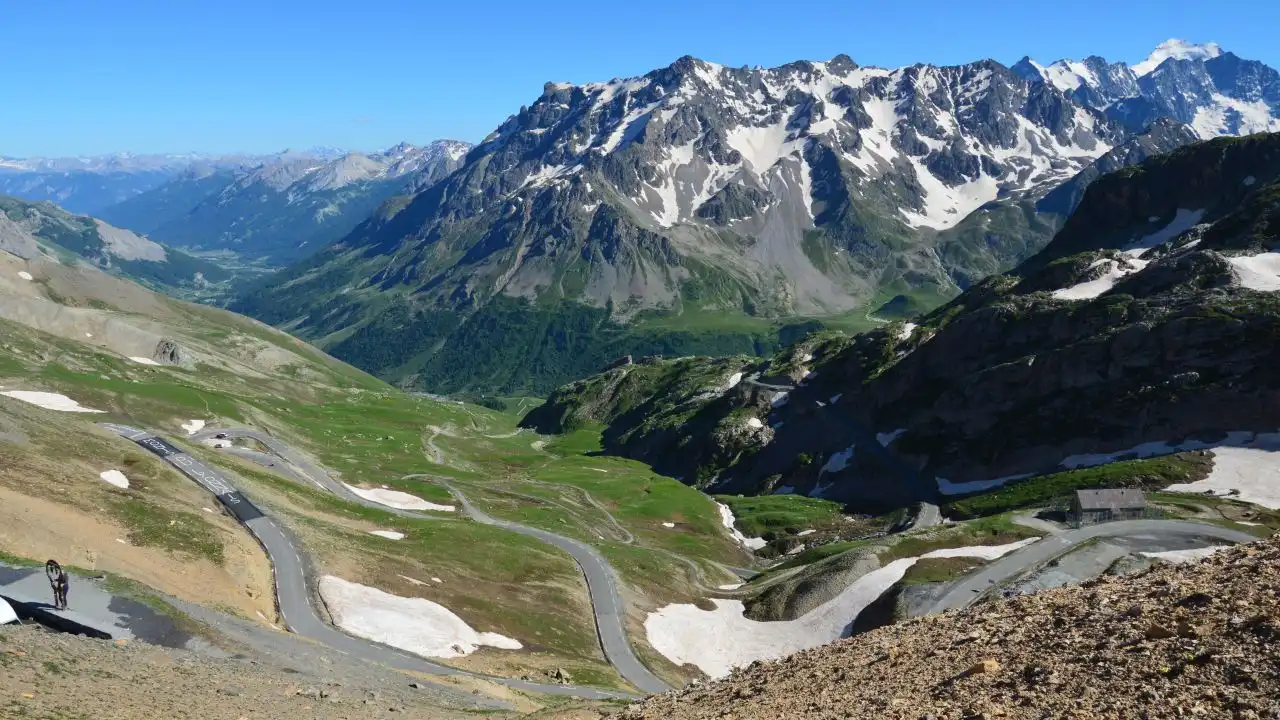
Driving the French Alps: The Route des Grandes Alpes Pass by Pass
The Verdon Gorge. The Col de l’Iseran. Alpe d’Huez. The Tour de France’s most celebrated climbs. The French Alps go in a completely different direction — and reward every kind of driver who finds them.
The French Alps are not the Alps most people picture when they plan a driving or riding trip to Europe. The Stelvio, the Dolomites, the Swiss passes around Andermatt — those are the famous ones, the ones that appear on bucket lists and in magazine features. The French Alps sit to the west, connected to the rest of the Alpine chain but with a distinct character: passes that the Tour de France has used for a century to separate the strongest climbers from the rest, a canyon that has no equivalent in continental Europe, and roads that reward a sports car as generously as anything the Italian or Swiss Alps offer — with considerably less traffic on many of the best sections.
The Route des Grandes Alpes — the classic road that runs from Geneva to Nice, stringing together the region’s finest passes — is the framework most touring itineraries draw from. Whether you approach from Geneva in the north, Nice and the Côte d’Azur from the south, or Milan from the east through the Italian approaches, the French Alps reward the driver or rider who arrives with time to explore rather than a schedule to keep.
From the North — The Geneva Gateway
Geneva is the classic starting point for the Route des Grandes Alpes and the most natural entry point for drivers and riders arriving from the UK, northern Europe, or North America via Zurich. The road south from Geneva through the Arve valley toward Chamonix is one of the great Alpine approaches — the scale of Mont Blanc and its satellites becoming visible from the valley floor before a single pass has been climbed. The mountain announces itself early and emphatically.
From Geneva, the Route des Grandes Alpes runs south through the full length of the French Alps to Nice — a sequence of passes that covers almost every road in this article. The northern section adds roads that southern approaches don’t reach: the Col des Aravis above Annecy, the Cormet de Roselend above Beaufort, and the Col du Mont Cenis before the Iseran and Galibier sequence begins in earnest. Drivers and riders with time to explore the northern French Alps before heading south have the strongest case for Geneva as their base.
From the South — The Nice and Côte d’Azur Gateway
Nice and the Côte d’Azur offer the Mediterranean entry point — the Route des Grandes Alpes in reverse, beginning at sea level with the Maritime Alps rising immediately behind the coast. The road north from Nice opens with passes that the Geneva and Milan approaches miss entirely: the Col de Turini — famous as one of the most demanding stages of the Monte Carlo Rally, with night-stage hairpins that have decided the rally more than once — and the dramatic Gorges du Cians, a red-rock canyon road carved through narrow gorges that narrows to single-track width in places.
The Mediterranean light and warmth make this approach particularly appealing in May and September, when the northern Alpine valleys can still feel wintry. Arriving from the south also means the passes build in altitude gradually as you head north — the Col de la Lombarde, the Bonette, the Vars and Izoard, the Galibier and Iseran — which gives the driving a satisfying sense of escalation. The Col de Turini alone justifies the Nice approach for anyone who has never driven a rally stage road in a sports car.
From the East — The Italian Gateway via Milan
Milan is a less obvious gateway than Geneva or Nice but the natural choice for anyone connecting a French Alps trip with the Italian passes to the east — the Dolomites, the Stelvio, or the Swiss passes around Andermatt. The approach from Milan through the Ligurian Apennines adds an Italian opening chapter before France begins — ridge roads through chestnut forest, descents into river valleys, and roads that carry almost no traffic because they connect places most travelers bypass on the autostrada below. They are better than their modest reputation suggests.
Cuneo, the natural overnight stop before the Franco-Italian border crossing, is one of Piedmont’s most appealing towns — a grid of arcaded streets at the foot of the Maritime Alps, with a food culture shaped by its position at the crossroads of Italian and French influence. From Cuneo the Col de la Lombarde crosses into France: a properly surfaced, rarely crowded pass through the Maritime Alps that introduces the French Alpine character before the more famous passes begin. This is the approach Blue Strada uses on its French Alps Miata tour — and for those building a broader Italian and French Alps itinerary, it is the logical way to connect the two.
The Verdon Gorge — Europe’s Grand Canyon
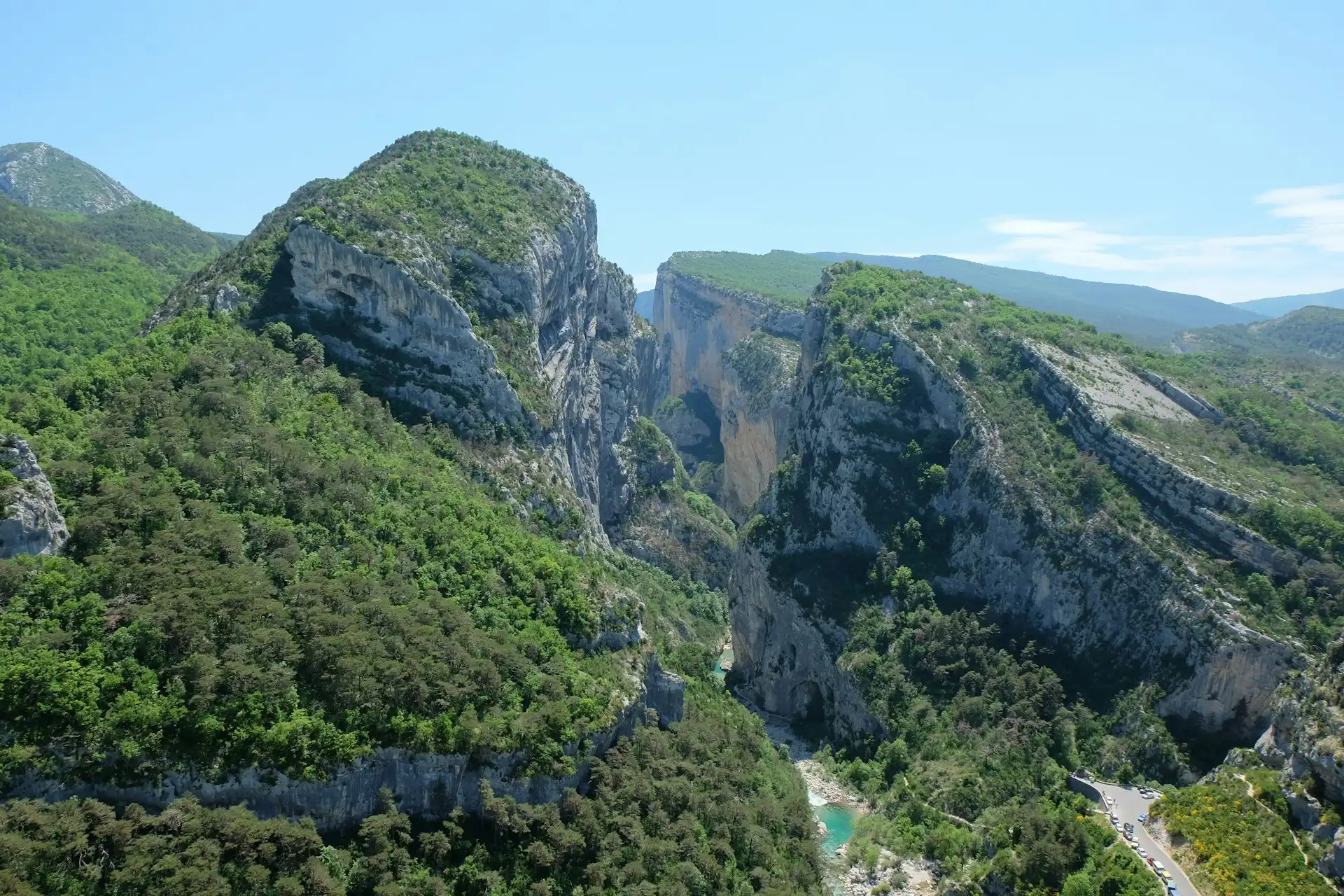
Nothing in the French Alps prepares you for the Verdon Gorge. The canyon is up to 700 meters deep, carved by the Verdon river through limestone over millions of years, with walls that drop vertically to turquoise water far below. It is the largest river canyon in continental Europe, and the roads along its rim are unlike anything else in the region.
The Route des Crêtes follows the southern rim with viewpoints that look straight down to the river and across to the opposite walls. It is not a driving road in the technical sense — it is narrow, slow, and designed for the view rather than the pace. A motorcycle has a particular advantage here: the ability to stop anywhere along the rim without the geometry of a car to manage, and the sensory connection to the landscape that makes the canyon feel larger than it already is. Convertible drivers will want the top down regardless of temperature.
Moustiers-Sainte-Marie, the village at the western end of the gorge, is one of the most beautiful small towns in Provence — built into a cliff face, with a star on a chain suspended between two rock walls above. It is the natural base for a full day in the Verdon, and worth every hour of it.
Cime de la Bonette — The Highest Asphalted Road in the Alps
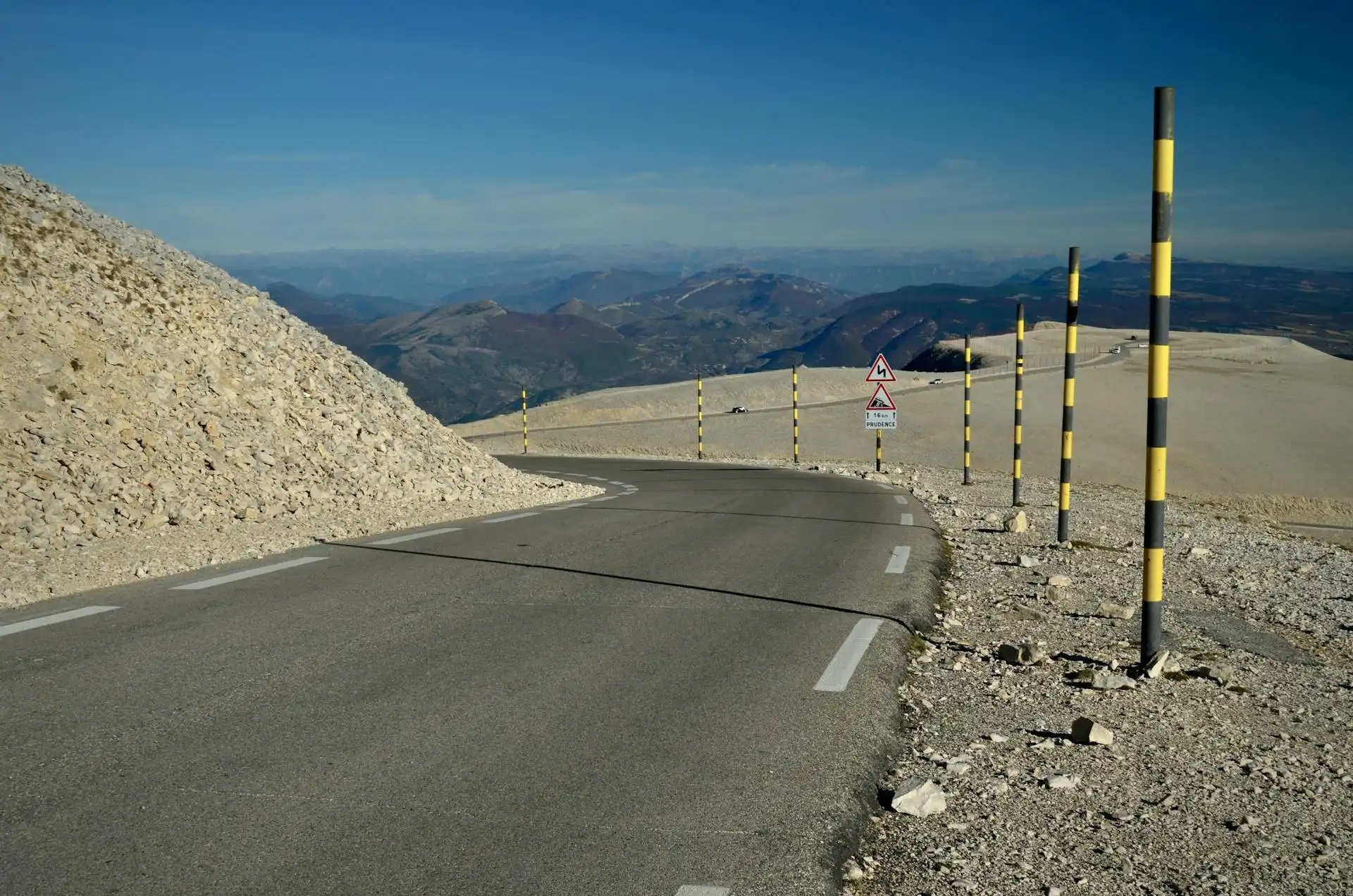
The Cime de la Bonette (2,802m) is the highest asphalted road in the Alps — a distinction earned through a summit loop that pushes the elevation just above the Col de l’Iseran. The pass itself sits at 2,715m, making it the fourth-highest pass in the Alps, but the loop road at the top reaches 2,802 meters — above which there is nothing but rock, sky, and a panorama that extends across the surrounding peaks in every direction.
The approach from the south through the Tinée valley is a long, sustained climb through increasingly barren terrain. One experienced Alpine driver describes it as his favorite pass in France: “It starts in the middle of green nature and you arrive at the top that seems to be on the moon. Vegetation and colors change as you go up — the road is smooth with a mixture of straights and wide curves so you can drive at a brisk pace and look around.” That description is equally accurate from a motorcycle seat. The descent toward Barcelonnette on the north side is faster and more flowing — the two approaches are different enough to justify doing both directions if time allows.
The Col d’Izoard — The Moonscape Pass
The Col d’Izoard (2,360m) is considered one of the most atmospheric passes in the French Alps, and the reason becomes clear on the southern approach: the Casse Déserte, a moonscape of pale limestone towers and scree slopes that looks like it belongs on a different planet. The contrast with the green slopes below is sudden and complete — and for a sports car driver or motorcyclist arriving through it, it is one of those moments that stops you whether you planned to stop or not.
The northern descent into the Guisane valley is fast and sweeping — a marked contrast to the austere southern approach. The Izoard has featured regularly in the Tour de France, and the names of riders who have dominated here on the climb — Coppi, Bobet, Merckx — are carved into the rock near the Casse Déserte. For drivers and riders who are also cycling enthusiasts, the Izoard carries emotional weight beyond the road itself.
Col de Vars — The Connector
The Col de Vars (2,109m) is the pass that links the southern French Alps to the more famous northern passes — a Summit at a natural crossroads between the Ubaye valley and the Durance. It is a Tour de France regular and a well-maintained road with consistent character: not as dramatic as the Izoard or as high as the Bonette, but a solid, rewarding pass that flows well for any vehicle. The exposed summit section is worth the roof-down commitment even on a cool day.
Briançon and the Col de Montgenèvre
At 1,326 meters, Briançon is the highest city in Europe — a Vauban-designed fortress town with UNESCO-listed ramparts, sitting at the confluence of five valleys. It has been strategically important since the Romans chose it as a garrison point, and it still feels like a place where roads converge for a reason. For driving and riding itineraries, it is the natural hub of the southern French Alpine passes — Izoard to the south, Lautaret and Galibier to the north, Montgenèvre to the east.
The Col de Montgenèvre (1,854m) is the lowest and most historically significant of the Franco-Italian border crossings — Hannibal is believed to have crossed the Alps here in 218 BC, though historians have never fully settled the debate. The road today is well-surfaced and gentler than its neighbors, making it an excellent half-day loop from Briançon for those who want additional road time without full commitment to another major pass. The Susa Valley on the Italian side is worth dropping into before returning.
Alpe d’Huez — The Most Famous Climb in Cycling
In the world of cycling, Alpe d’Huez needs no introduction — 21 numbered hairpin bends rising from Bourg d’Oisans to the ski resort at 1,860 meters, each bend named after a Tour de France winner. As a driving or riding road it is equally extraordinary. The 21 bends take roughly 40 minutes to drive from the bottom — steep, relentless, with the valley expanding below at every corner. For motorcyclists, the rhythm of the switchbacks is the kind of technical challenge that makes the climb genuinely engaging rather than just scenically impressive. For a convertible driver, the gradient and the views make it one of those roads you drive with complete attention and complete satisfaction.
Alpe d’Huez sits north of the main cluster of southern French Alpine passes — reaching it from Briançon requires a full day’s extension through the Romanche valley, which puts it outside itineraries that don’t allow for it. Bourg d’Oisans at its foot is the natural base for exploring the northern French Alps independently, with the Col du Glandon, Col de la Croix de Fer, and Col de la Sarenne all within range.
Col du Glandon and Col de la Croix de Fer
The Col du Glandon (1,924m) and the adjacent Col de la Croix de Fer (2,067m) are Tour de France regulars that driving and riding enthusiasts consistently rank among the finest roads in the northern French Alps. The Glandon’s final section above Saint-Colomban-des-Villards is technically demanding — gradients reaching 11% — with picture-perfect hairpin corners and the Glandon river far below. The Croix de Fer summit opens to panoramic views that make the effort worthwhile regardless of how you arrived.
Both passes sit in the Bourg d’Oisans and Maurienne Valley area — naturally combined with Alpe d’Huez into an exceptional day’s driving or riding circuit from a base in the valley. This is the part of the French Alps where a full week based in one location makes more sense than a single pass-and-move itinerary.
Col de la Madeleine — The Maurienne Classic
The Col de la Madeleine (1,998m) has appeared 25 times in the Tour de France since 1969 — one of the iconic climbs of the French Alps and a pass that experienced Alpine drivers consistently add to the list once the Galibier and Iseran are done. The approach from the Maurienne Valley is a sustained climb to a broad summit with views that extend across the surrounding peaks, and the road character is flowing rather than technical — well-suited to a sports car that wants to carry speed through corners rather than negotiate hairpins one at a time.
The Madeleine sits in the Maurienne Valley northeast of Briançon — a region that north-bound itineraries pass through on the way to the Galibier area. Saint-Jean-de-Maurienne, the main town in the valley, calls itself the world’s capital of uphill cycling, which gives some indication of the road density in the area. Combined with the Télégraphe and Galibier from a valley base, the Madeleine makes an exceptional circuit.
Col du Télégraphe and Col du Galibier — The Classic Pairing
The Col du Télégraphe (1,566m) and the Col du Galibier (2,642m) are almost always discussed together — the Télégraphe is the approach from Saint-Michel-de-Maurienne to Valloire, and the Galibier rises immediately above it. The Télégraphe is a sustained climb through forest, consistent and well-surfaced, with a character that shifts from wooded to alpine as altitude increases. By itself it is a good road. As the approach to the Galibier, it is indispensable context.

The Galibier is one of the most celebrated climbs in cycling — the pass that separated Fausto Coppi from everyone else in the 1952 Tour de France, and that has defined Alpine stages ever since. The northern approach from Valloire via the Télégraphe is the more dramatic side — a relentless climb to a summit that arrives suddenly above a final series of hairpins. The view from the top, with the Meije to the south and the Écrins massif visible in the distance, is one of the finest in the French Alps. In a roadster, the exposed summit plateau delivers exactly the kind of moment that justifies the drive from wherever you started. On a motorcycle, the combination of altitude, gradient, and scenery is as rewarding as anything in the Alps.
Col du Lautaret — The Gateway Pass
The Col du Lautaret (2,058m) connects the Briançon valley to the Galibier and the Romanche — a wide, well-surfaced crossing of the main Alpine divide that serves as the junction for the routes above it. It is a beautiful road in its own right, with the glaciated north face of the Meije massif visible from the summit plateau, but its significance is as much logistical as scenic: the Lautaret is where itineraries divide and where the passes of the northern French Alps become accessible. Drive it heading north from Briançon and the Galibier is immediately above you. Drive it heading west and Bourg d’Oisans and Alpe d’Huez are within reach.
Col de l’Iseran — The Highest Pass in the Alps
The Col de l’Iseran (2,764m) is the highest alpine pass open to regular traffic in the Alps — higher than the Stelvio, higher than the Bonette loop road. The approach from Val d’Isère in the north is the most famous — a steady climb through increasingly dramatic terrain with Mont Blanc visible on clear days from the upper sections. The southern approach from Bonneval-sur-Arc is the less-traveled side: narrower, steeper, more remote, and arguably more rewarding for the driver or motorcyclist who prefers to arrive at a summit having earned it rather than having followed the tourist route.
In a convertible, the Iseran summit is as close to the top of the driving world as a road reaches — the altitude is physical, the air is noticeably thinner, and the panorama is complete in every direction. On a motorcycle, the Iseran at altitude delivers a sensory experience that is genuinely different from the passes below it. Allow time at the summit regardless of what comes after.
Little St. Bernard Pass — The Historic Crossing
The Little St. Bernard Pass (2,188m) sits at the Franco-Italian border — the crossing that connects the Aosta Valley in Italy to the Tarentaise in France, used since antiquity. The road is well-surfaced and the gradients manageable; it is more significant for its history and position than its technical demands. The descent into Aosta is the reward — a long sweep into the valley with the Grand Combin and Mont Blanc massif behind, and Italy below. After a day that covers the Télégraphe, Galibier, Lautaret, and Iseran, the Little St. Bernard is the punctuation mark that confirms the day is complete.
The Italian Lake Return — Orta and Maggiore
For those completing a circuit back toward Milan, the return through the Italian lake district is a deliberate change of pace after the intensity of the pass days. Lake Orta — the smallest and least visited of the major northern Italian lakes, with a medieval island in its center — carries almost none of the traffic that affects Como or Garda. The road along its western shore is unhurried and beautiful. Lake Maggiore, larger and more famous, with the Borromean Islands visible from the shore road, is the final approach to Milan. In a convertible with the top down, the lake district is exactly the right way to close a week in the mountains.
Practical Notes for Drivers and Riders
Pass opening dates. The French Alpine passes typically open from June to October. The Iseran, Galibier, and Bonette close in winter and may not fully open until mid-June depending on snowfall. Check current status before departure — passes can also close briefly after summer snowfall at altitude.
The Tour de France. The Galibier, Télégraphe, Vars, Izoard, and Madeleine are regular Tour de France climbs. The race runs late June to late July — if your dates coincide, check stage schedules. Roads can be closed for hours on race days, which is worth planning around rather than against.
Two wheels vs four. Motorcyclists have a particular advantage on the Verdon Gorge rim roads — the ability to stop anywhere and the sensory connection to the landscape. Sports cars have the advantage on the flowing northern passes — the Galibier, Madeleine, and Lautaret reward a car that can carry speed through long sweeping corners. The Izoard and Bonette work well for both.
Verdon Gorge. The Route des Crêtes along the gorge rim is narrow and has a one-way section. Follow the marked circuit direction — attempting to drive it in reverse creates significant problems in the narrowest sections.
Tolls. French autoroutes have tolls. The mountain passes themselves are toll-free, but transit on French highways requires payment. Budget accordingly for the approach and return legs.
Fuel. Available in valley towns. The Bonette, Galibier, and Iseran summits have no fuel facilities. Fill up before climbing — running low on the Iseran approach is an avoidable problem.
Weather. The southern French Alps around the Verdon can be significantly warmer than the northern high passes at the same elevation. Above 2,000 meters, cold and wet conditions are possible at any time of year. A waterproof layer is not optional — and on a motorcycle, wind chill at the Iseran summit is considerably more significant than the air temperature suggests.
Driving and Riding the French Alps with Blue Strada
Blue Strada’s French Alps Miata tour approaches the region from Milan — through the Ligurian Apennines and across the Maritime Alps via the Col de la Lombarde, arriving in France from the Italian side rather than the more conventional Geneva approach. The Ligurian roads serve as an excellent opening chapter, and the Lombarde crossing establishes the character of what follows: remote, well-surfaced, and largely traffic-free.
The tour covers the Verdon Gorge, the Cime de la Bonette, the Col de Vars and Col d’Izoard, Briançon with a free day and Montgenèvre loop option, then the Col du Télégraphe, Galibier, Lautaret, and Iseran in a single extraordinary day — arriving in Aosta via the Little St. Bernard before the lake return to Milan. The roads not on the standard tour — Alpe d’Huez, the Madeleine, the Glandon — sit north in an area that a day’s extension from Briançon or Bourg d’Oisans reaches comfortably.
Those who want the Stelvio, the Dolomites, and the Swiss passes in the same trip are better served by a different direction from Milan — northeast rather than southwest. The Italian Alps and Swiss Alps guides cover that territory. The French Alps are their own argument — and a compelling one for anyone arriving on two wheels or four.
Blue Strada Alps Miata Driving Tours
Three different Alpine itineraries — the French Alps and Verdon Gorge, the Dolomites and Switzerland, or the museums and mountain passes. All starting from Milan.
No Responses