
The Stelvio, Twice: Inside the Dolomites & Austrian Alps Motorcycle Tour
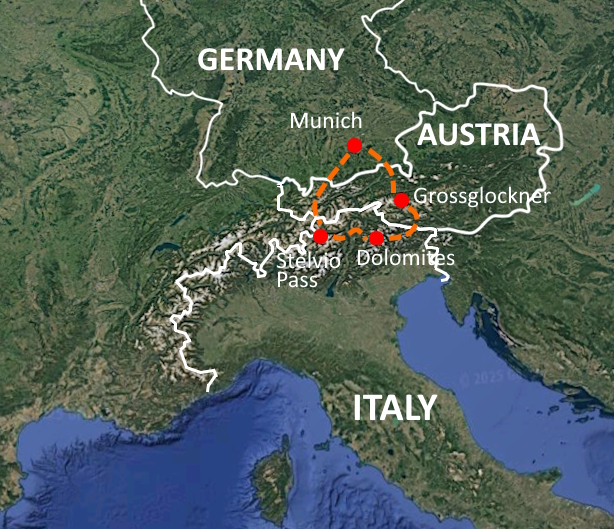
Eight nights. Six touring days. The Grossglockner, the Sella Ronda, and the Stelvio — twice, from opposite directions. Munich to Munich, through Germany, Austria, Italy, and Switzerland.
Blue Strada’s Dolomites & Austrian Alps tour covers familiar ground for anyone who has ridden the Alps before — the Stelvio, the Dolomites, the passes above Merano — but the route is built differently from the tours that start in Milan. Beginning and ending in Munich changes the character of the whole week. The first day climbs into Austria rather than Italy, which means the opening road is the Grossglockner High Alpine Road rather than a Dolomite pass. The sequence matters: Austria first, then Italy, then a three-night base in Merano for two full loop days including the Stelvio — in both directions, on two separate days — before the return to Munich through Switzerland. It is a tour that earns its name. The Austrian Alps are not an introduction to the Dolomites; they are half the point.
What follows is a detailed look at the route, the roads, and what it means to start this tour in Munich rather than Milan — including what the city itself offers before and after the riding begins.
Munich — The Right City to Start From
Munich is not an accidental choice of gateway. It is one of Europe’s most rewarding cities for a day or two before a riding tour, and the logistics work: Munich Airport (MUC) has direct connections from most of North America and the rest of Europe, the city center is 40 minutes from the airport by train, and the riding begins within two hours of leaving the city on Day 1.
Arriving a day early — which Blue Strada recommends on all tours — gives genuine options in Munich. The Englischer Garten is larger than Central Park and sits in the middle of the city; the Marienplatz and the Viktualienmarkt are within walking distance of most central hotels; the Deutsches Museum has the finest collection of motorcycles and automobiles in Europe, which is a reasonable way to spend an afternoon before a week of riding. The beer halls are well-documented and do not require further promotion here.
For riders who want more time, Augsburg is 70 kilometers west of Munich and 35 minutes by regional train — one of Germany’s oldest cities, with a Roman-era old town, the Renaissance Fuggerei (the world’s oldest social housing complex, still occupied), and the kind of compact, walkable center that rewards a half-day without demanding a full one. It is an easy add-on for anyone arriving two days before the tour. The Romantic Road, which connects Augsburg to Füssen and the Bavarian Alps, is worth considering as a day ride or drive if time allows — the stretch from Augsburg south through Landsberg and Schongau covers some of the finest Bavarian countryside in the region.
After the tour, Munich rewards the same approach. A night in the city before the flight home — dinner, a walk, one more beer hall — is a better ending than an early morning transfer to the airport and a long wait at the gate.
Day 1 — The Grossglockner
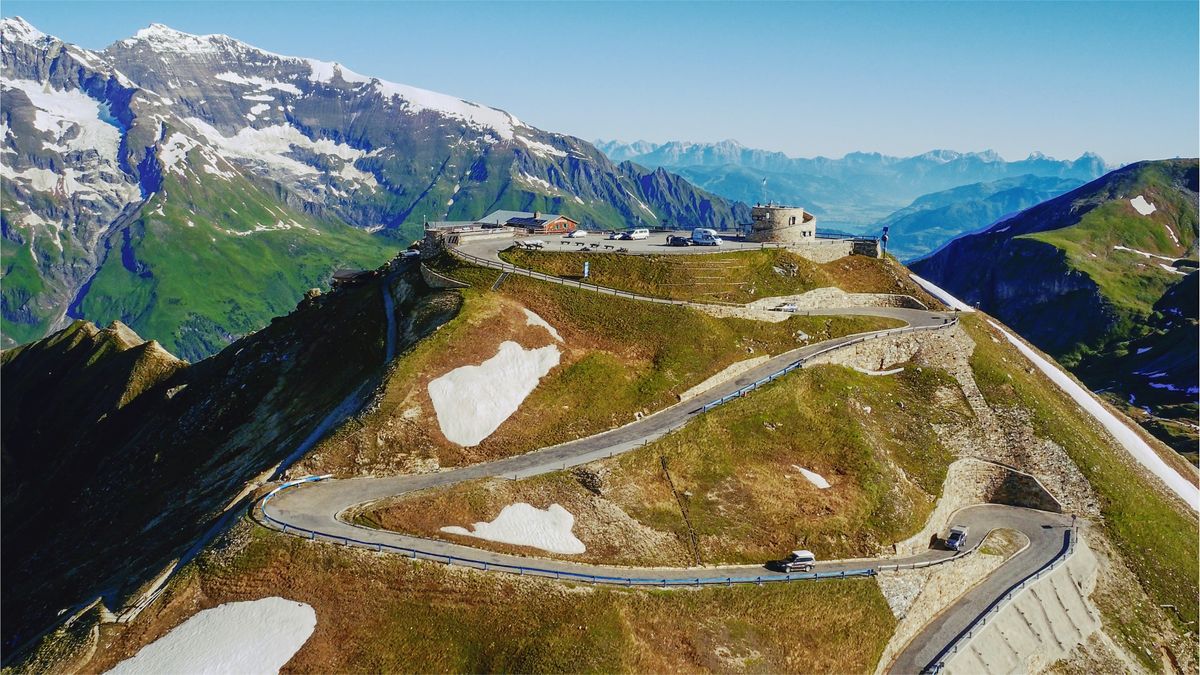
The first riding day leaves Munich and heads south into Austria, with the Grossglockner High Alpine Road as the destination. The Grossglockner Hochalpenstrasse is Austria’s most famous mountain road and one of the great Alpine passes by any measure: 36 kilometers of purpose-built mountain road climbing to 2,504 meters (8,215 ft), with the Grossglockner peak — Austria’s highest mountain at 3,798 meters — visible across the glacier to the south on a clear day. The road was built in the 1930s and shows it, in the best sense: wide, well-engineered, designed to make the most of the landscape rather than simply cross it.
The Edelweiss Peak spur road — a short detour from the main pass to the Edelweissspitze viewpoint at 2,571 meters (8,435 ft) — is the highest point on the tour and one of the highest road-accessible viewpoints in the Eastern Alps. The panorama from the top covers more than 30 peaks above 3,000 meters. The overnight is at a mountain hotel at 2,304 meters — waking up above the clouds on Day 2 is not a figure of speech on this tour.
The Grossglockner sets a tone that the rest of the week builds on rather than surpasses. It is a confident opening: a road with a genuine reputation, in a country where the Alpine riding is underrated precisely because Switzerland and Italy get more attention. Austria’s speed limits are more relaxed than Switzerland’s on many mountain roads, and the surface quality is excellent throughout.
Day 2 and 3 — Into the Dolomites
Day 2 descends from the Grossglockner and crosses into Italy, arriving in Cortina d’Ampezzo — the Pearl of the Dolomites, host of the 1956 Winter Olympics, and one of the most scenically placed towns in the Alps. Cortina sits in a high valley bowl surrounded by the Dolomite peaks on all sides; arriving by motorcycle on a clear day, with the pale limestone towers overhead and the town below, is the kind of moment that earns its own section in the ride report.
Day 3 is a loop day based in Cortina, crossing the Tre Croci, Pura, and Mauria passes through the eastern Dolomites. These are less-traveled passes by Dolomites standards — not the famous Sella Ronda circuit, which comes later, but tighter, quieter roads with fewer tour buses and more sustained technical interest. The Tre Croci connects Cortina to the Misurina lake area and crosses into the Cadore valley; the Mauria links the Cadore back toward Cortina through a landscape of meadows and forest that is markedly different from the exposed rock-face riding of the higher passes. Two nights in Cortina means no packing and unpacking between Day 2 and Day 3 — a detail that matters after a riding day.
Day 4 — Seven Passes and the Sella Ronda
Day 4 is the most ambitious day on the tour: seven passes between Cortina and Merano, including the Sella Ronda four-pass loop. The Sella Ronda — Passo Sella, Passo Pordoi, Passo Gardena, Passo Campolongo, encircling the Sella massif in the heart of the Dolomites — is the centerpiece of Dolomite riding and earns that status. Each pass has a distinct character; the circuit as a whole gives a comprehensive survey of what the Dolomites actually are, in a way that riding one or two passes does not. In a morning, you understand the Dolomites. By the afternoon arrival in Merano, the contrast between the tight Dolomite hairpins and the broader valley roads of the approach to Merano underlines how much ground the day has covered.
Merano is the base for the next three nights — the longest stay in one place on the tour. The city sits at the intersection of three valleys in South Tyrol, at a low enough altitude to have a mild climate and a palm-tree-lined promenade alongside the Passirio river. It is an unusual place to end up after a day of Dolomite passes: elegant, unhurried, and very much its own thing. The three-night stay is what makes the loop days on Days 5 and 6 work — no packing, no transit, just two days of riding out from and back to the same base.
South Tyrol is one of the best eating regions in Europe — which fits with how Blue Strada tours tend to work. Some guests describe them as foodie tours with great roads attached. Merano as a three-night base, with two loop days and no luggage to pack, leaves plenty of time to test that description.
Days 5 and 6 — The Stelvio, Twice
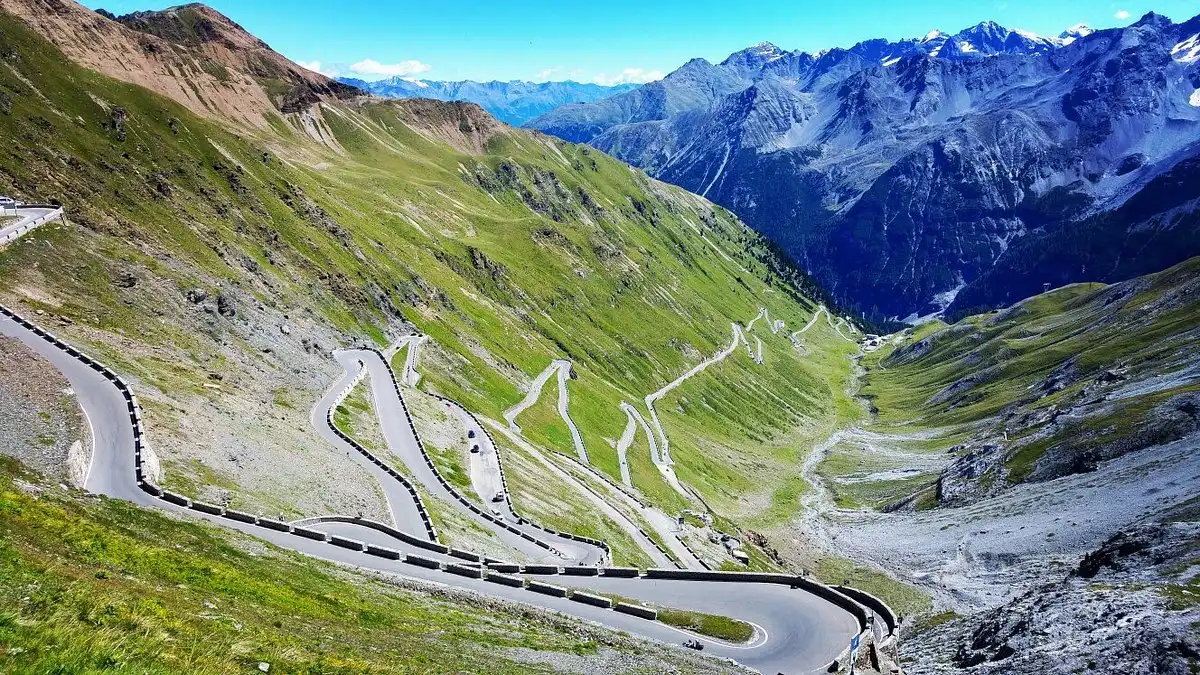
Day 5 loops from Merano over the Mendola, Tonale, and Gavia passes before reaching the Stelvio from the east — the Prato allo Stelvio side, 48 hairpins, the approach that most riders who know the Stelvio know. The Mendola and Tonale are warm-up passes by the standards of what follows; the Gavia, which peaks at 2,618 meters and has sections barely wide enough for two vehicles, is a technical road in its own right that the Stelvio tends to overshadow in the ride report. The Stelvio from the east in the afternoon, with a morning of good passes behind you and the descent to Bormio ahead, is the tour’s first summit moment — the reference point against which everything else on the day is measured.
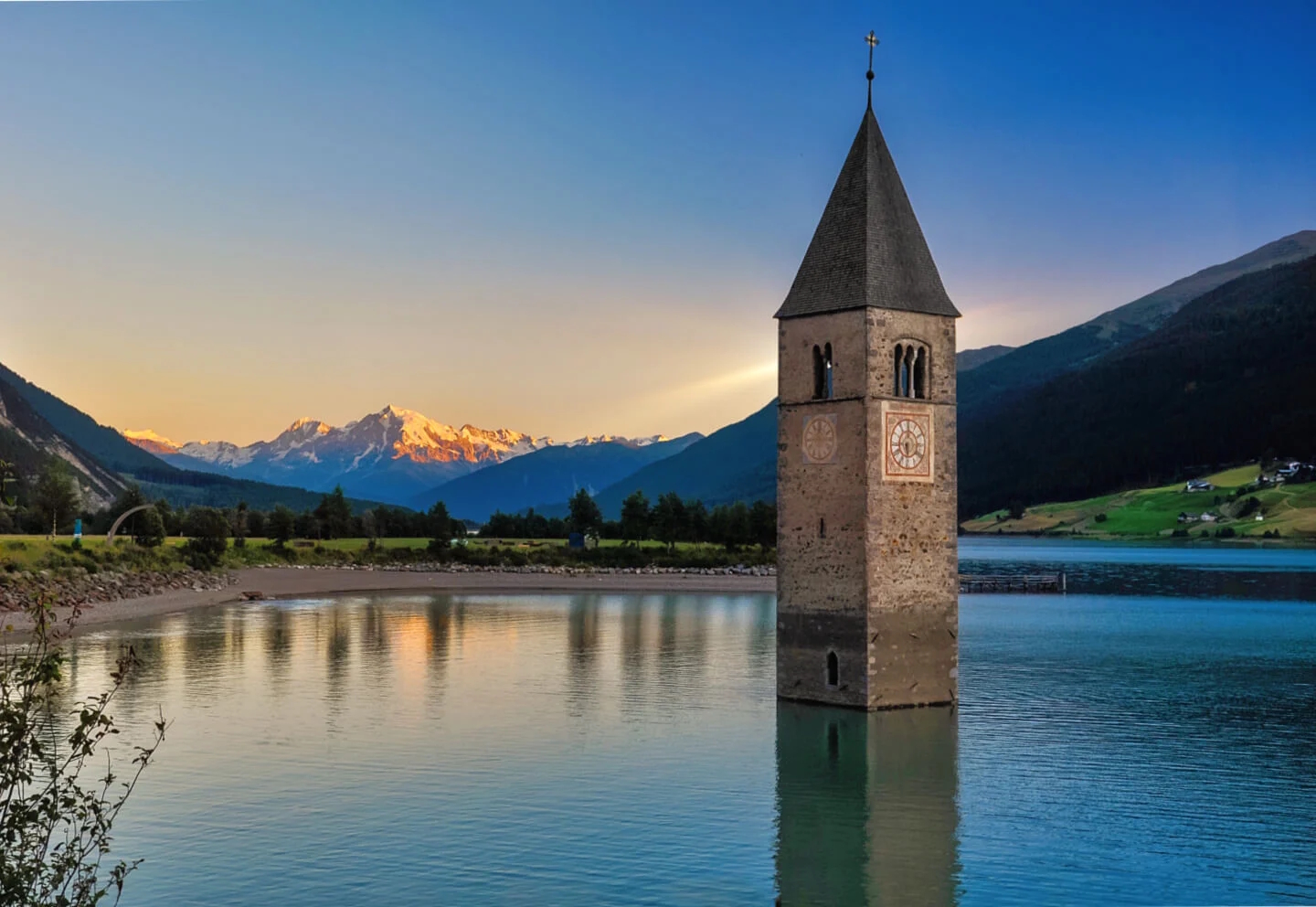
Day 6 returns to the Stelvio from the opposite direction. The route loops into Switzerland via the Resia Pass — notable for the submerged 14th-century bell tower that protrudes from Lake Resia, the only visible remnant of the village flooded when the reservoir was created — before crossing back into Italy over the Stelvio from the Swiss side. The western approach is different in almost every respect from the eastern one: fewer hairpins, a broader road, a longer climb through the upper valley before the summit. Riders who think they know the Stelvio after Day 5 discover on Day 6 that they knew half of it. The two-day Stelvio sequence is the detail that most riders mention first when describing this tour.

Day 7 — Back to Munich via Switzerland
Day 7 crosses the Giovo Pass — a quieter road through the South Tyrolean hills east of Merano — and rides north through the Inn valley and Bavaria back to Munich. The return day is not a roads day in the same sense as Days 1 through 6; it is a transit day with good scenery, and it functions as the natural decompression after the Stelvio sequence. The Inn valley north of Innsbruck is fast and efficient; the Bavarian stretch approaching Munich is unremarkable. The tour finishes as it began: in Munich, with a city that rewards the last night before the flight home.
For riders who want to extend, the Bavarian Alps south of Munich — the Zugspitze area, Garmisch-Partenkirchen, the Deutsche Alpenstrasse — are within day-ride range on the final day before departure. None of it matches what the previous six days covered, but it is pleasant riding and a reasonable use of an extra day if the schedule allows.
How This Tour Differs from the Italian & Swiss Alps
Blue Strada’s Italian & Swiss Alps tour covers some of the same passes — the Stelvio appears on both — but the structure and emphasis are different. The Italian & Swiss Alps is built around Milan and focuses heavily on Switzerland: the Furka, the Grimsel, the Susten, and the free day in Andermatt. The Dolomites & Austrian Alps tour spends no time in Switzerland beyond the Day 6 loop, and dedicates more time to the Dolomites themselves — three days in and around Cortina and the Sella Ronda area, versus a transit on the Italian & Swiss Alps tour.
The Munich gateway also changes who the tour suits. Riders flying from North America have more direct Munich options than Milan options on some routes, and the city itself is a more natural European city break than Milan for most non-Italian visitors. Neither tour is a subset of the other; they share the Stelvio and the general Alpine geography, and that is roughly where the overlap ends.
Book the Dolomites & Austrian Alps Motorcycle Tour
Munich to Munich. The Grossglockner, the Sella Ronda, the Stelvio twice — 1,700 km through Germany, Austria, Italy, and Switzerland. Check the tour page for current dates and availability.
View the Dolomites & Austrian Alps Tour →
No Responses