
Above the Tree Line: A Driver’s Guide to the Italian Alpine Passes
48 hairpins. 2,758 meters. The Dolomites, the Stelvio, and the passes most drivers never find.
The Italian Alps divide opinion among serious driving enthusiasts in a way that almost no other region does. The Stelvio Pass has been called the greatest driving road in the world — a title also claimed, with equal credibility, by Sardinia’s SS125 and Portugal’s N222. The Alps, though, are not really a single-road argument. They are the most concentrated collection of great driving roads on earth, and the Stelvio is the most famous entry point into that collection. And also, by people who drove it on a busy summer Saturday and spent most of the time behind a tour bus, significantly overrated. The Dolomites are a UNESCO World Heritage Site with passes that appear on every serious bucket list — and roads that are genuinely narrower, steeper, and more demanding than anything in Switzerland.
Both assessments are correct. The Italian Alps reward drivers who arrive with the right expectations: these are dramatic, challenging, occasionally chaotic roads through some of the most extraordinary landscape in Europe. They are not the Swiss passes — smoother, more consistent, better maintained. They are something else entirely. And for a certain kind of driver, they are the better choice precisely because of that.
This article covers the Italian Alpine passes worth knowing — the ones on Blue Strada’s tour routes, and the ones nearby that logistics don’t always allow. The Swiss passes get their own article. Both are worth reading before deciding which you want more.

The Dolomites — A UNESCO Landscape You Drive Through
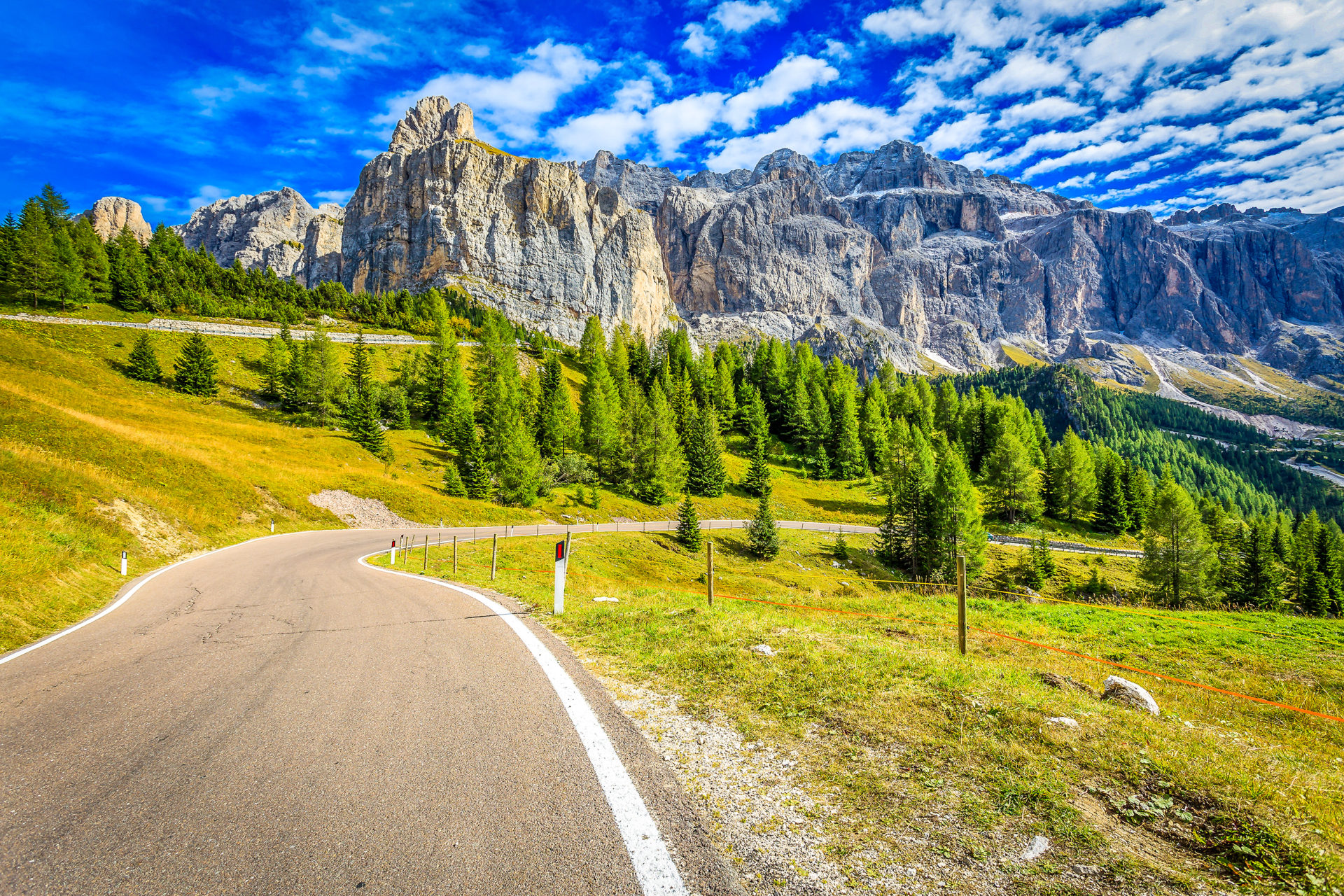
The Dolomites are not just a scenic backdrop. The limestone rock formations that give the region its UNESCO designation also give it its road character — the pale rock reflects light differently than granite at different times of day, the passes cross exposed high terrain with sudden dramatic views, and the villages that punctuate the valleys are genuinely medieval rather than tourist reconstructions.
The driving here is tighter and more technical than Switzerland. Dolomite pass roads are narrower, steeper in places, and have a more adventurous feel than their Swiss counterparts — passes like the Stelvio, Passo Gardena, Passo Sella, and Passo Pordoi feature tight hairpin turns where oncoming traffic requires careful negotiation. Road surfaces are generally good but not as consistently perfect as Switzerland. That is either a drawback or part of the appeal, depending on your temperament.
The Fassa Valley, which sits at the heart of the Dolomite pass network, is the natural base — from here the major passes radiate outward in every direction, and a well-planned day can cover four or five of them without retracing the same road twice.
The Sella Ronda — Four Passes, One Loop
The Sella Ronda is the most famous driving circuit in the Dolomites — a loop of four passes around the Sella massif that can be driven in either direction and is different enough each way to justify doing both.
Passo Sella (2,240m) is the tightest and most technical of the four — narrow switchbacks, steep gradients, and views directly into the vertical faces of the Sella group above. Passo Pordoi (2,239m) is the most dramatic — a long exposed climb to a summit plateau with a panorama that extends across the western Dolomite massif. Passo Gardena (2,121m) descends into the Val Gardena with a commitment that rewards drivers who trust the road. Passo Campolongo (1,875m) is the most accessible of the four — a gentler pass that provides the link between the others and a moment to breathe between the technical sections.
The Sella Ronda is also one of the most popular cycling circuits in the Dolomites, which means cyclists are a genuine presence on the road. Early mornings are significantly better than midday for this reason, and for the roads themselves — the light on the limestone at 7am is worth setting an alarm for.
The Manghen Pass — The One the Tour Buses Miss
The Manghen Pass (2,047m) is what serious Dolomite drivers talk about when they want to avoid the Sella Ronda crowds. Connecting the Valsugana valley in the south to the Fassa Valley in the north, the Manghen is narrow, demanding, and largely unknown outside the Italian motorcycle and sports car community. It has no cable cars, no summit restaurants, no souvenir shops — just a challenging mountain road through genuinely remote terrain.
The southern approach from Telve di Sopra is the more technical side — tight switchbacks on a road that sometimes narrows to single-track width, where passing requires one car to reverse to a wider section. That sounds like a deterrent. For the right driver, it is a recommendation. The northern descent into the Fassa Valley is faster and more flowing, with views of the Dolomite massif appearing on the horizon as the road descends.
The Manghen is on Blue Strada’s Motorhead Alps tour for exactly this reason — it is the pass that earns its inclusion by difficulty and reward rather than by fame.
The Stelvio — Legend, Reality, and How to Drive It Right
The Stelvio Pass (2,758m) requires an honest introduction. Top Gear called it the greatest driving road in the world in 2008, which was generous and also a curse — the resulting fame means that summer weekends on the eastern approach from Prato allo Stelvio can feel more like a slow procession than a driving experience. For what it’s worth, we’ve also written about Sardinia’s SS125 and Portugal’s N222 in similar terms — each has a credible claim to that title in its own category. The Alps, though, are not really a single-road argument. They are the most concentrated collection of great driving roads on earth, and the Stelvio is the most famous entry point into that collection.
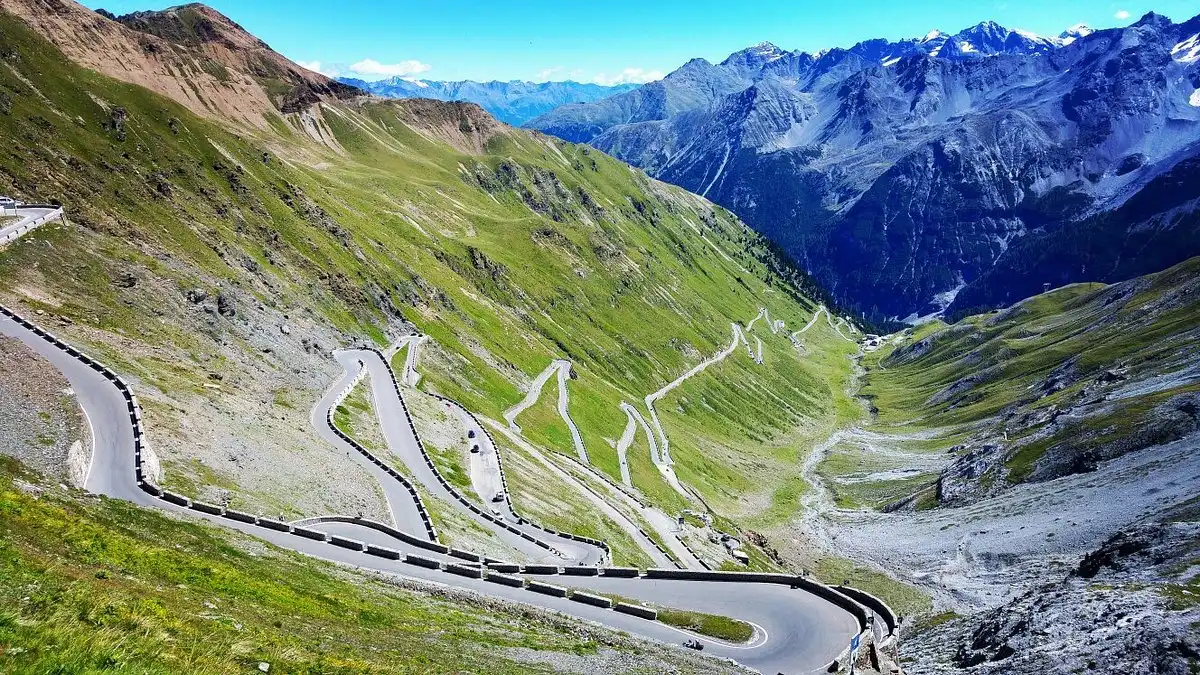
The Stelvio at its best, however, is extraordinary. The second-highest paved pass in the Alps with 48 legendary hairpin bends on the eastern approach — numbered and visible from below in a wall of switchbacks that is genuinely unlike anything else in the Alps. The road was built between 1820 and 1825 by Austrian engineers connecting the Empire’s territories across the mountains. It was built to last. It has.
The key to the Stelvio is timing. Early morning or late evening rides often provide the best experience — avoid peak hours, especially on busy passes like the Stelvio. Weekdays are significantly better than weekends in July and August. The western approach from Bormio is wider with easier hairpins and less traffic than the eastern side — the eastern approach is the one in the photographs, the western descent is the one that flows. In a convertible or roadster, the Stelvio on a quiet morning is as close to the Top Gear verdict as the road gets.
Bormio, at the foot of the western descent, is worth a stop regardless — a beautiful medieval town with Roman thermal baths carved into the mountain above it. The Bagni Vecchi thermal spa, accessible by a road that climbs above the town, has been in use since Roman times. After a morning on the Stelvio, it is exactly the right place to be.
The Umbrail — The Stelvio’s Better-Kept Secret
Branching from the Stelvio summit toward the Swiss border, the Umbrail Pass (2,501m) is Switzerland’s highest fully paved pass — and the road that serious Alpine drivers recommend in the same breath as the Stelvio, without the same crowds. It’s challenging without being scary, and way less crowded than the Stelvio — you actually get to enjoy the ride instead of dodging buses and tourists. The views are stunning — alpine meadows, dramatic drops, snow-capped peaks in the distance, every switchback opening up another postcard panorama.
The Umbrail crosses from Italy into Switzerland at the summit, and the transition in road character is almost immediate — the surface improves, the markings become more precise, and the guardrails appear with Swiss regularity. Blue Strada’s Alps tour crosses both the Stelvio and the Umbrail in a single day, which is the right way to experience both.
Lake Iseo and the Alpine Approach from Milan
Milan is the natural gateway to the Italian Alps — served by two international airports (Malpensa and Linate), 60 to 90 minutes from the Alpine foothills depending on direction, and with Tuscany three hours south and Sardinia reachable by ferry from Livorno. It is why Blue Strada is moving its home base to Milan for 2027: the tours radiate in every direction from there, and for guests flying in from North America, the connections are better than most people expect. Those who have done Rome before — and most repeat Blue Strada guests have — will find Milan a genuinely different starting point. Rome is a direct high-speed train ride away if the urge strikes. Lake Como and Venice are considerably closer.
The approach to the Italian Alps from Milan sets the tone for everything that follows — and the road along the western shore of Lake Iseo is the right way to make that approach. Iseo is the least-visited of northern Italy’s major lakes, which means the road carries a fraction of the traffic that affects Como or Garda. The lake sits between limestone cliffs, long and narrow, and the road along it is an excellent warm-up for the mountain driving ahead — winding, well-surfaced, and largely empty.
Madonna di Campiglio, the mountain resort town at the end of the first day’s driving, marks the transition point where the valley roads give way to the Alpine passes proper. The town is known primarily as a ski resort, but the roads approaching it from the south — through the Brenta Dolomites and the Rendena Valley — are excellent driving in their own right, with the jagged Brenta massif appearing suddenly above the treeline.
What’s Nearby But Not Always on the Route
Two passes deserve mention for drivers extending their Italian Alpine itinerary independently, even though logistical constraints — accommodation locations, daily distances, road widths — mean they don’t always appear on guided tour routes.
The Mortirolo Pass (1,852m) is famous in cycling circles as one of the most brutal climbs in the Giro d’Italia — a road so steep and narrow that it barely qualifies as a driving road at all. In a car, it is an exercise in commitment and patience rather than flow. Worth experiencing once; not a daily recommendation.
The Gavia Pass (2,621m) is another story entirely — a proper high-altitude pass with hairpins, dramatic scenery, and a road surface that varies considerably between sections. It is significantly less traveled than the Stelvio and shares some of the same mountain terrain from a different angle. Bormio connects both the Stelvio and the Gavia within a short distance, which makes that area a natural hub for an extended Italian Alpine stay.
Across the Austrian border, the Grossglockner High Alpine Road (2,504m) is the Austrian answer to the Stelvio — Austria’s most visited attraction, 48 km through Hohe Tauern National Park with guaranteed glacier views. It is a toll road and one of the most engineered Alpine experiences available — spectacular, but very much a managed tourist destination rather than a raw mountain pass. Blue Strada’s Motorhead Alps tour crosses into Austria on its broader circuit through Germany and the car museums; the Austrian and German roads deserve their own article.
Practical Notes for Italian Alpine Drivers
Timing. The Dolomite passes are open from roughly late May to early November, weather permitting. July and August guarantee that every pass is fully open — which is not always the case in May or June after a heavy winter. The trade-off is traffic on the most famous passes, particularly the Stelvio on summer weekends. Early morning departures make a significant difference — the Stelvio in the first hours after the road opens is a fundamentally different experience from the same road at midday on a Saturday. Alpine weather in July and August is also more reliably warm and clear than later in the season, and the mountain temperatures offer a welcome contrast to the heat of the Italian cities below. September has its appeal — quieter roads, early autumn light — but some higher passes begin closing with the first autumn snowfall, and the unpredictability increases. As with most things Alpine, timing is a compromise, and knowing which corners to drive early makes the summer dates more rewarding than the general advice suggests. (Claudio, for the record, has done the Alps in winter on a motorcycle. That is a different kind of commitment entirely.)
Cyclists. The Sella Ronda and Stelvio are popular cycling destinations. Cyclists have right of way on Alpine passes in Italy; give them space and expect to encounter them on every major pass. Early morning departures reduce the overlap significantly.
Road surfaces. Generally good on the major passes, variable on minor roads. The Manghen and similar lesser-traveled passes can have rough sections, especially after winter. The Stelvio surface on the hairpin sections is well-maintained given the traffic it carries.
Pass widths. The Dolomite passes are narrower than Swiss equivalents. On some sections, meeting a tour coach requires patience and sometimes reversing to a wider point. This is normal and part of the experience — not a flaw in the road.
Fuel. Available in valley towns. Summit facilities exist on the Stelvio and Pordoi but at elevated prices. Fill up before climbing and you won’t need to think about it.
ZTL zones. Some Dolomite villages and resort towns have restricted traffic zones. Cortina d’Ampezzo in particular has ZTL restrictions. Check before driving into historic centers.
Driving the Italian Alps with Blue Strada
Blue Strada’s Italian & Swiss Alps tour begins with two days in the Dolomites — four Italian passes, the Fassa Valley, the transition through the Stelvio and Umbrail into Switzerland. The Italian section alone covers more great driving than most enthusiasts manage in a week of independent travel, with the added advantage of a guide who has driven these passes across every season and knows which corners the maps don’t explain.
If the Stelvio is the specific goal, both the Italian & Swiss Alps tour and the Motorhead Alps tour include it. The French Alps tour — which heads southwest from Milan rather than northeast — does not, and for good geographic reasons. The French Alps article — coming soon in our Destinations & Roads section — explains what that tour finds instead, which is a compelling case in its own right.
This year’s Alps tour has a particular addition: Swift — Blue Strada’s newly acquired Yamamoto Signature Edition MX-5, one of only four ever built — makes her first tour appearance on the Alps. A car built to Yamamoto-san’s philosophy of lightness and connection, on the passes that define European mountain driving.
The Swiss passes that follow the Italian section get their own article — see Where the Traffic Takes the Tunnels: A Driving Guide to the Swiss Alpine Passes.
Blue Strada Alps Driving Tours
Three different Alpine itineraries — the Dolomites and Switzerland, the museums and mountain passes, or the French Alps and Verdon Gorge. All starting from Milan.
No Responses