
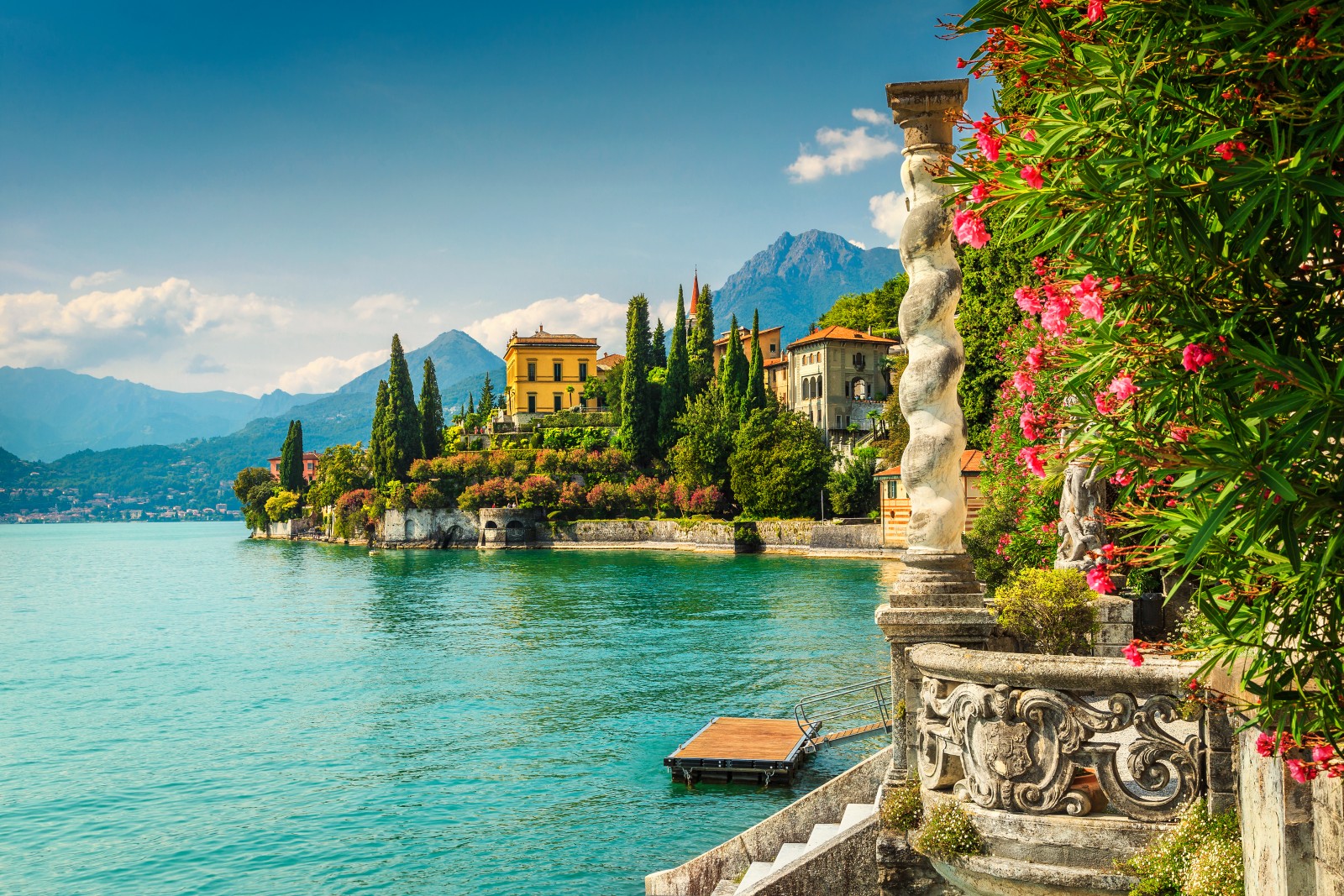
Five Lakes, Five Days: A Driver’s Guide to Lake Como and Northern Italy’s Hidden Waters
Lake Como is famous for good reason. What’s less known is how extraordinary it is to drive — and that its neighbor lakes are even better kept secrets. A convertible driver’s guide to the five lakes of Northern Italy.
Lake Como has a reputation problem — but not the kind you might expect. Everyone knows it is beautiful. The postcard villas, the turquoise water, the mountains dropping straight into the lake. It has been a destination for European aristocracy since the Roman Empire and for Hollywood since George Clooney discovered it in 2002. What gets lost in all of that is that Lake Como is also, road for road, one of the finest driving destinations in Northern Italy.
The problem is the crowds in the towns, not the roads themselves. Any driver who has taken the SP583 — the western shore road that winds from Como through Cernobbio, Moltrasio, and Laglio before climbing toward Menaggio — will tell you the same thing: narrow, relentless, spectacular. The asphalt follows every contour of the shoreline. The water appears and disappears between the garden walls of the old villas. Then the road climbs and the lake opens beneath you.
But Lake Como is only part of the story. The lakes of Northern Italy are not a single destination — they are a system. Lake Maggiore to the west, Lake Orta hiding behind it, Lake Como further east, Lake Lecco to the south. Each has a distinct character. Each has roads that connect them through mountain passes and pre-alpine valleys that most visitors in tour buses never find. For a driver in a convertible sports car, that road network is the real attraction.
The Road That Opens Everything: Passo del Cuvignone
Most routes into the Northern Italian lakes region arrive from the south via the autostrada — a practical but unremarkable approach. The alternative is to enter through the Valcuvia valley and climb the Passo del Cuvignone, and the difference in arrival experience is not subtle.
The Cuvignone rises to 1,044 meters above the eastern shore of Lake Maggiore, from the village of Cittiglio in the Province of Varese. The road is narrow and tree-lined on the lower slopes — the legendary Italian cycling champion Alfredo Binda, born in Cittiglio, trained on these roads in the early twentieth century, and Ivan Basso used them decades later. The gradient averages 8.5 percent over the 9.4-kilometer climb, with sections touching 16 to 17 percent. In a sports car with the roof down, the views open progressively as altitude increases — Lake Maggiore appearing in glimpses between the trees before the summit clears the treeline entirely and the full panorama breaks open.
From the top, the descent toward Laveno-Mombello on the eastern shore is tighter still — the kind of mountain road where speed is not the point and concentration is everything. It delivers you to the lakeside feeling like you have earned the view.
Lake Maggiore — The Lake With a Statue of Liberty Connection
Lake Maggiore is the second-largest lake in Italy and the most underestimated by drivers passing through to Como. That is a navigational error. The lakeside road along the Lombardy shore — the SP69 heading south from Laveno through a sequence of small villages — offers the kind of unhurried, intimate waterside driving that the more famous shore roads can lose when summer traffic builds.
Near the southern end of the lake, just outside Arona, stands one of the more surprising roadside encounters in Italy: the Colossus of San Carlo Borromeo, locally known as the Sancarlone. The copper and bronze statue stands 35 meters tall on a hilltop overlooking the lake — completed in 1698, and for nearly two centuries the tallest statue in the world. It held that title until the Statue of Liberty was completed in New York in 1886. The Statue of Liberty’s sculptor, Frédéric Auguste Bartholdi, reportedly drew partial inspiration from the Sancarlone — meaning the world’s most recognized statue has a less-famous predecessor standing on a hillside above Lake Maggiore that most of its admirers have never heard of.
You can climb inside through a spiral staircase to the head, where openings in the eyes and ears provide a peculiar view of the lake below. It is exactly the kind of stop that rewards curiosity over efficiency.
The Mottarone — A Mountain Between Two Lakes
Between Lake Maggiore and Lake Orta stands Monte Mottarone at 1,491 meters — the dominant peak of the local range and one of the finest driving mountains in Northern Italy. The road from Armeno on the Lake Orta side (provincial road SP41) opens gently through the village before the asphalt widens and the rhythm of the curves establishes itself. The surface is in excellent condition throughout; the views expand steadily as the road gains altitude.
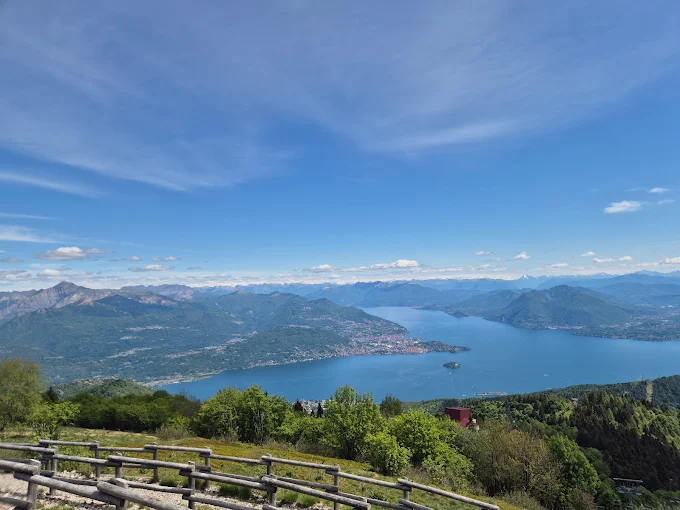
Monte Mottarone at 1,491 meters — on a clear day, seven lakes are visible from the summit.
The claim made about Mottarone, and it is not an overstatement, is that on a clear day the summit offers views of seven lakes simultaneously: Maggiore, Orta, Varese, Mergozzo, Monate, Comabbio, and Biandronno — along with the Monte Rosa massif and, on exceptional days, the Po Valley and Milan’s skyline in the distance. A 1954 New York Times article listed the view from Mottarone among the ten most fascinating in the world.
The descent toward Stresa on the Maggiore side runs along the Strada Borromeo — a private toll road still owned by the Borromeo family, opened to cars in 1948. It is a different character from the Armeno approach: wider, more manicured, with the lake visible for the full descent. The combination of both approaches — up one side, down the other — makes the Mottarone a natural day-within-a-day on any lake region itinerary.
Lake Orta — The One They Keep to Themselves
There is a reason the Italian lake regulars tend to keep Lake Orta to themselves. It is smaller than Maggiore and Como, quieter in every season, and — for a driver following the lakeside road that hugs its eastern shore — completely unhurried in a way that the more famous lakes can no longer guarantee in summer. The road passes colored villas, small bathing inlets, and stone walls before arriving at the promontory village of Orta San Giulio.
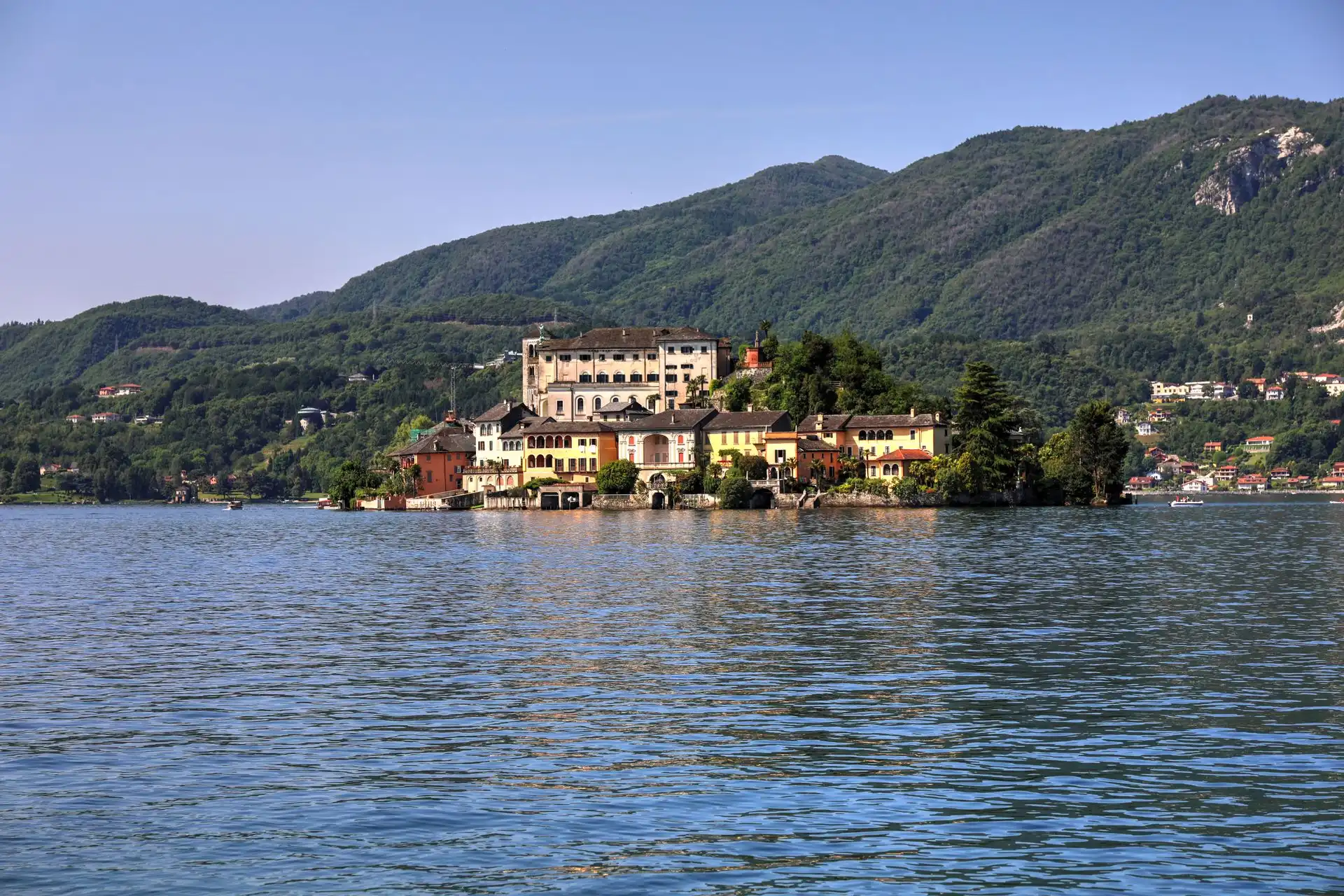
Orta San Giulio — the island 400 meters offshore holds a fourth-century basilica and a community of Benedictine nuns who have taken a vow of silence.
Orta San Giulio is one of the most beautiful villages in Piedmont — a medieval old town of frescoed facades, cobbled lanes, and small piazzas descending to the lakefront, where the island of San Giulio sits 400 meters offshore. The island holds a fourth-century basilica and a community of Benedictine nuns who have taken a vow of silence — a detail that lends the place a particular stillness, even in the height of summer. The ferry crossing from Piazza Motta takes five minutes. Most visitors spend considerably longer than they planned.
What Lake Orta offers that its larger neighbors cannot match is the experience of an Italian lake town that has not been entirely reorganized around tourism. The restaurants serve the local population as well as visitors. The piazzas are not lined with souvenir stalls. It is a place that repays walking slowly and having lunch without a schedule.
Lake Como — The Road That Earns the View
The approach to Lake Como from the west — through the pre-alpine valleys via Rancio Valcuvia and Valganna — is one of the route’s quieter pleasures. The road passes through chestnut forest and small villages before the terrain opens toward the Swiss border region near Porlezza, where the first glimpse of the lake’s eastern branch appears near Argegno as the road descends toward the shore.
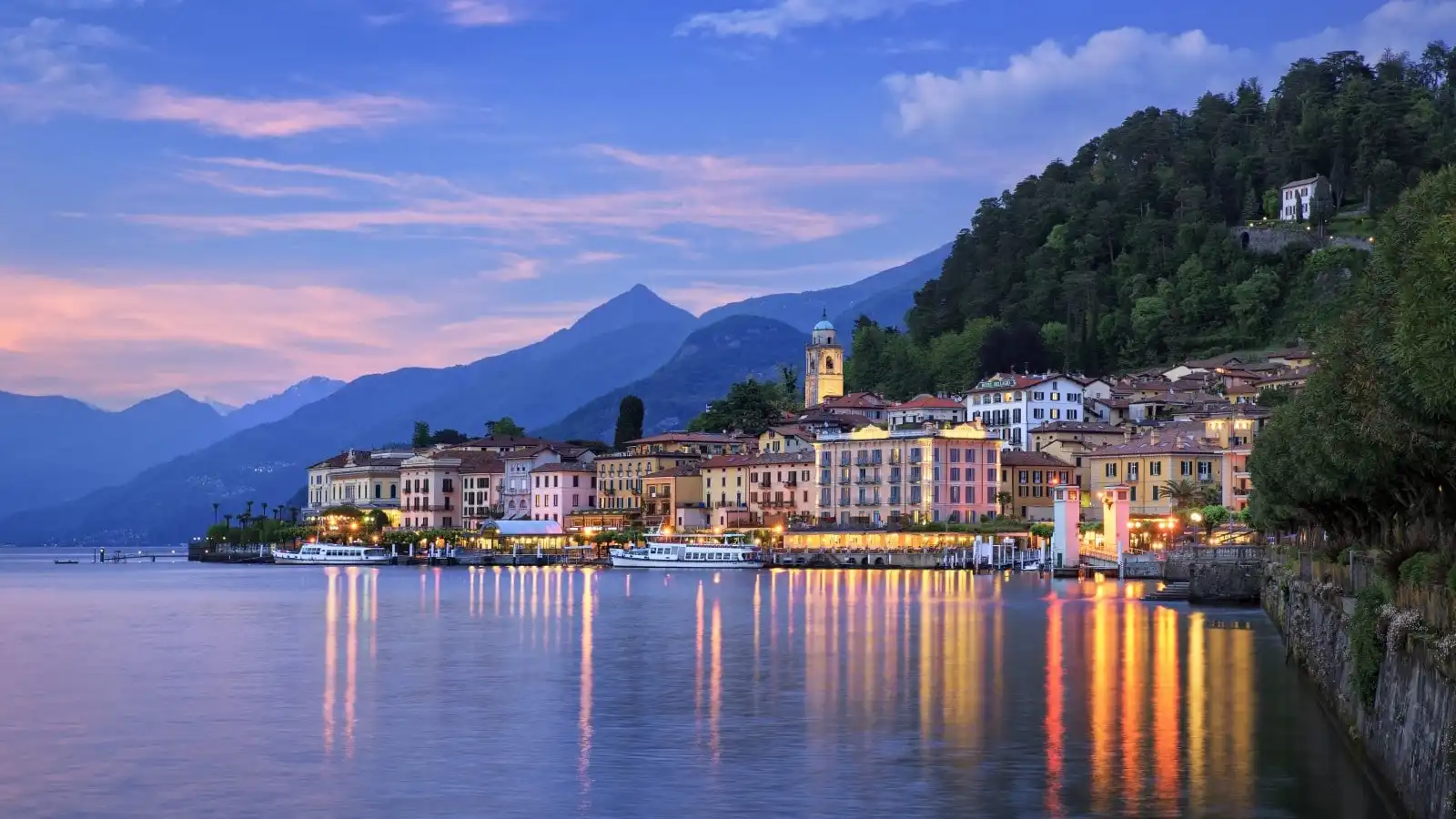
The SP583 western shore road — narrow, relentless, spectacular. The water appears and disappears between the garden walls of the old villas.
The eastern arm of the lake is the less-touristed of the two main branches, and for a driver it is often the better experience: the road is tighter, the towns smaller, the traffic more manageable. Varenna, on the eastern shore, is one of the lake’s most photogenic towns — the gardens of Villa Monastero cascade down to the water, and the view across to Bellagio at the lake’s branching point is the image that ends up on every Como postcard.
Bellagio occupies the point where the lake divides — a promontory between two deep, north-running arms with views in three directions. It is deservedly famous and correspondingly busy in summer. The cobbled streets and the gardens of Villa Serbelloni and Villa Melzi remain extraordinary regardless of the crowds; the instinct to arrive early and leave before the tour coaches is correct.
The full circuit of Lake Como — north along one shore, south along the other, closing the loop at Como before crossing back to Lecco — covers around 140 kilometers and requires a full day done properly. That means stopping at Varenna, stopping at Colico where the lake opens into true alpine scenery, and driving the SP583 western shore road as it winds through Laglio. The Clooney villa — the eighteenth-century Villa Oleandra, purchased in 2002 — is announced by a gate and a stone wall with no view of the house itself, and a local ordinance that discourages lingering. The correct response is to give the gate a friendly glance and keep moving. The road ahead is better than any villa garden.
Why the MX-5 Is the Right Car for These Roads
The Northern Italian lake roads were built before the automobile existed and have been incrementally improved over a century without being fundamentally widened. They are not wide roads. The SP583 on the western shore of Lake Como, the passes of the Cuvignone and Mottarone, the approach roads around Orta San Giulio — these are roads where a compact roadster is not a compromise but an advantage. The Mazda MX-5 is 1,735mm wide. Larger sports cars and SUVs that photograph well on an Italian lakeside Instagram post become genuinely stressful to navigate when a coach appears around a blind corner above the water.
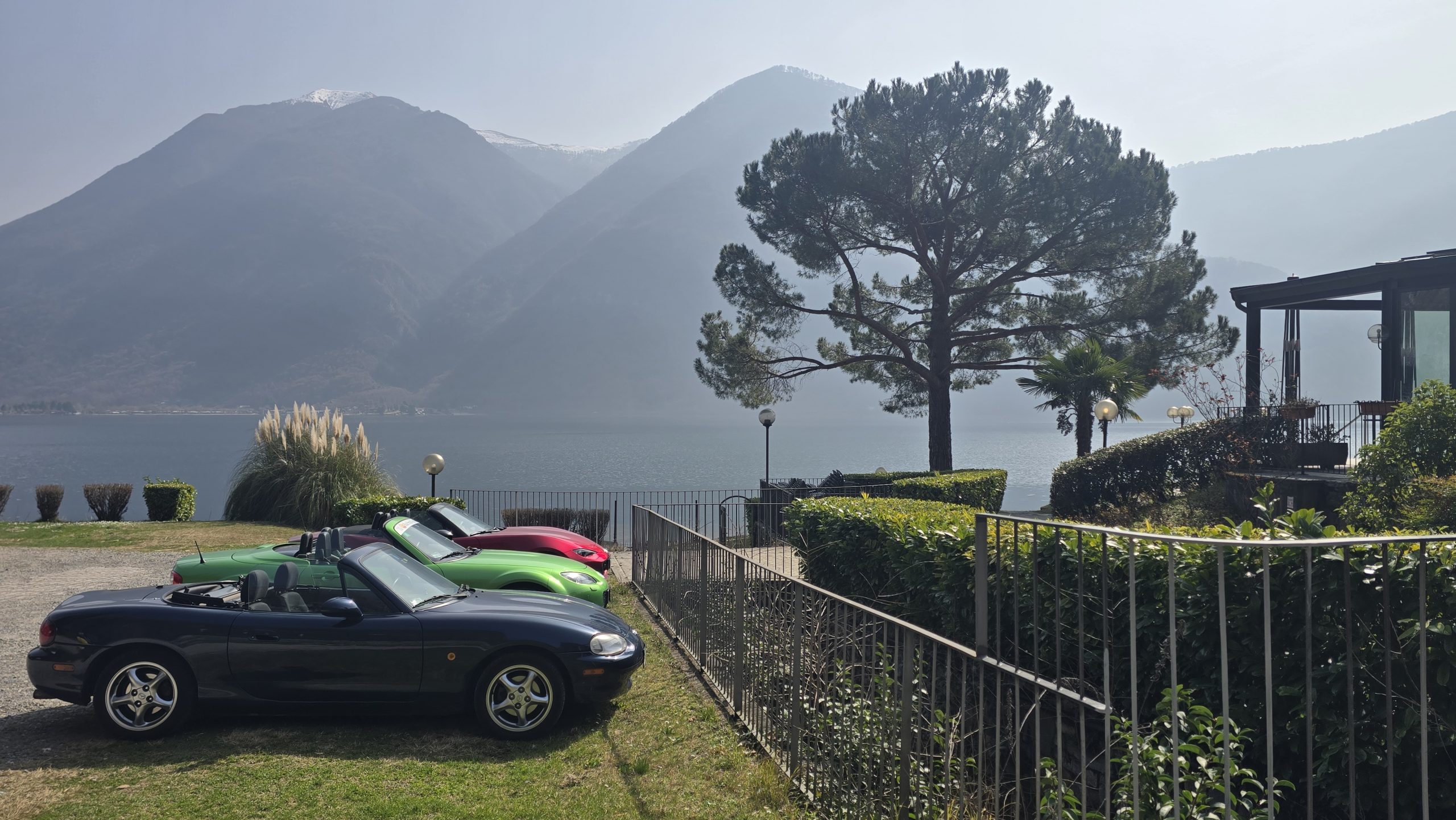
Blue Strada Miatas at Lake Como — the right car for roads that were built long before the automobile existed.
The other advantage is the roof. The lake views are not incidental to the driving — they are the architecture the roads were built around. Every approach, every summit, every descent has been positioned by geology to produce a specific panorama at a specific moment. Driving those roads with a closed roof is like visiting a gallery and looking at the floor. The MX-5 with the roof down does not just improve the experience — it is the correct instrument for this particular piece of landscape.
The Five-Lake Circuit
Most visitors to the Italian lakes choose one — a week on Como, a weekend on Maggiore — and experience it thoroughly. The alternative, and for a driver the more rewarding one, is to treat the lake system as a single connected itinerary: Maggiore to Mottarone to Orta to Como to Lecco, linked by mountain roads that have more character than anything you will find by staying on the shoreline.
Each lake is distinct. Maggiore is elegant and grand, with the Borromean Islands and the Sancarlone and a sense of nineteenth-century formality that the others lack. Orta is intimate and genuine — the lake the locals go to. Como is famous for a reason, and the famous reason is correct: the combination of the deep water, the enclosing mountains, and the sequence of grand villas is genuinely unmatched. Lecco, at the southern end of the eastern arm, is a working Lombard city where the lake narrows to a river between limestone cliffs — the opposite of Como’s elegance, and worth the full circuit just to close the loop properly.
Five days through this landscape in a convertible sports car, on roads that most visitors in rental cars never find, stopping where the road stops being interesting rather than where the guidebook says to stop: that is what the lake region is actually for.
Book the Lake Como & Beyond Driving Tour
Five lakes, five touring days, starting and ending at Milan Malpensa. The Cuvignone, the Sancarlone, the Mottarone, Orta San Giulio, and the full Lake Como circuit — with premium accommodations and all breakfasts and dinners included.
View the Lake Como & Beyond Tour →
No Responses