
The Best Driving Roads in Portugal
- Home
- /
- BLOG
- /
- ROADS & DESTINATIONS
- /
- THE BEST DRIVING ROADS IN PORTUGAL
After our last Portugal tour, my wife shared some photos with friends who had also visited the country. Their reaction stopped us: they felt like they’d seen a completely different Portugal. They had — both trips started in Porto, but the Portugal most visitors see is Lisbon, the Algarve beaches, and the well-worn tourist path between them. Ours went north and inland: mountain passes, granite villages, terraced river valleys, and roads that most visitors never find. Many who venture into Portugal’s interior and north consider it the real Portugal — quieter, more authentic, and entirely off the radar of the standard itinerary. It also happens to be where the best driving roads in the country are. We were on a motorcycle. The same roads work just as well in a roadster.
Portugal has two of the most credentialed driving roads in Europe — and almost no traffic on either of them. The N222 through the Douro Valley has been called the best driving road in the world. The N304 through the Alvão mountains was named by Ford as potentially the greatest driving road in Europe. Both are in the same corner of the country. Both are largely unknown outside the enthusiast community.
That combination — extraordinary roads, minimal traffic, dramatic scenery, and world-class food and wine within reach of almost every stop — is what makes northern Portugal a driving destination that rewards anyone willing to look past the more obvious European classics.
The roads covered here form the backbone of Blue Strada’s Portugal tours — run in both Miata roadsters and on motorcycles. Both tours cover different routes through the country — Portugal is large enough and varied enough that no two itineraries repeat the same experience — but the roads below are the ones that define what driving in this country actually is.
The N222 — Avis Called It the Best Driving Road in the World
Avis crowned Portugal’s N222 as “the road that offers the best driving experience in the world” — specifically the 27-kilometer stretch between Peso da Régua and Pinhão, with exactly 93 bends and views over the Douro Valley. The methodology involved a quantum physicist, an F1 track designer, and a scoring system based on the ratio of straights to bends. It’s not a marketing claim — it’s the verdict of people who spent serious effort comparing the world’s great driving roads and landed here.
The Peso da Régua to Pinhão section is the centerpiece, but the full N222 runs 226 kilometers from Vila Nova de Gaia to Almendra, passing through the Alto Douro Wine Region — a UNESCO World Heritage Site — as well as the Côa Valley Rock Engravings, another UNESCO site. Three UNESCO designations along one road is unusual enough. The fact that it’s also genuinely excellent driving makes it remarkable.
The N222 is not an Alpine pass — it’s a river road through one of the most beautiful wine regions in the world, with 93 bends that keep you engaged without ever demanding more than you want to give. In a convertible or roadster with the top down, the Douro Valley below and the terraced vineyards rising on both sides, it lives up to every word of the title. Both Blue Strada’s Miata roadster and motorcycle tours drive it — and guests who do it tend to understand immediately why it keeps winning.
The N304 — Ford’s Candidate for the Greatest Road in Europe
In 2019, Ford named the N304 as one of the best driving roads for enthusiasts in Europe — scoring it ten out of ten for both thrill factor and scenery. The road crosses northern Portugal’s mountains through the Alvão Natural Park, 49 kilometers long, with a smooth surface, consistent curves, and views that change at every corner.
Where the N222 rewards patience and scenery, the N304 rewards commitment. The road climbs from Arco de Baúlhe in the south to Campeã in the north through the Serra do Marão and Alvão mountains — a sustained mountain climb with the kind of rhythm that makes a driver lose track of time. At the top, the plateau views over the Alvão Natural Park are the reward for the climb. The descent is the reward for the plateau.
The N304 and N222 are naturally combined into a single day’s driving — mountain road in the morning, river road in the afternoon — and that combination is arguably the finest single day of driving available in Portugal. Blue Strada’s Miata roadster tour does exactly this on Day 2, connecting Peneda-Gerês through the Alvão Natural Park via the N304 and down into the Douro Valley on the N222.
Peneda-Gerês National Park — Portugal’s Only National Park
Portugal has one national park. It is in the far northwest, on the Spanish border, and it is unlike anywhere else in the country. Peneda-Gerês is a wonderfully unspoiled rural region with mountain roads, small villages, and scenery that feels genuinely remote — small villages such as Soajo, Lindoso, and Pitões das Junias feel like little discoveries in a region that’s largely unknown among international tourists.
Soajo is the highlight for drivers — a village of espigueiros, the tall granite grain stores that appear in clusters on the hilltops above the valley, reached by roads that climb through increasingly dramatic landscape. The Vilarinho das Furnas reservoir, the mountain passes of the Serra da Peneda, and the Atlantic approach through Viana do Castelo and Ponte de Lima make the first day’s drive into the park one of the most varied in the tour: coastal road, historic towns, mountain passes, and a national park, all in 200 kilometers.
The park roads are narrow in places and populated by livestock — both of which are features rather than inconveniences, because they keep the pace honest and the experience genuine. This is not manicured driving country. It is raw and beautiful and worth every kilometer of it.
The Douro Valley — Three UNESCO Sites, One River
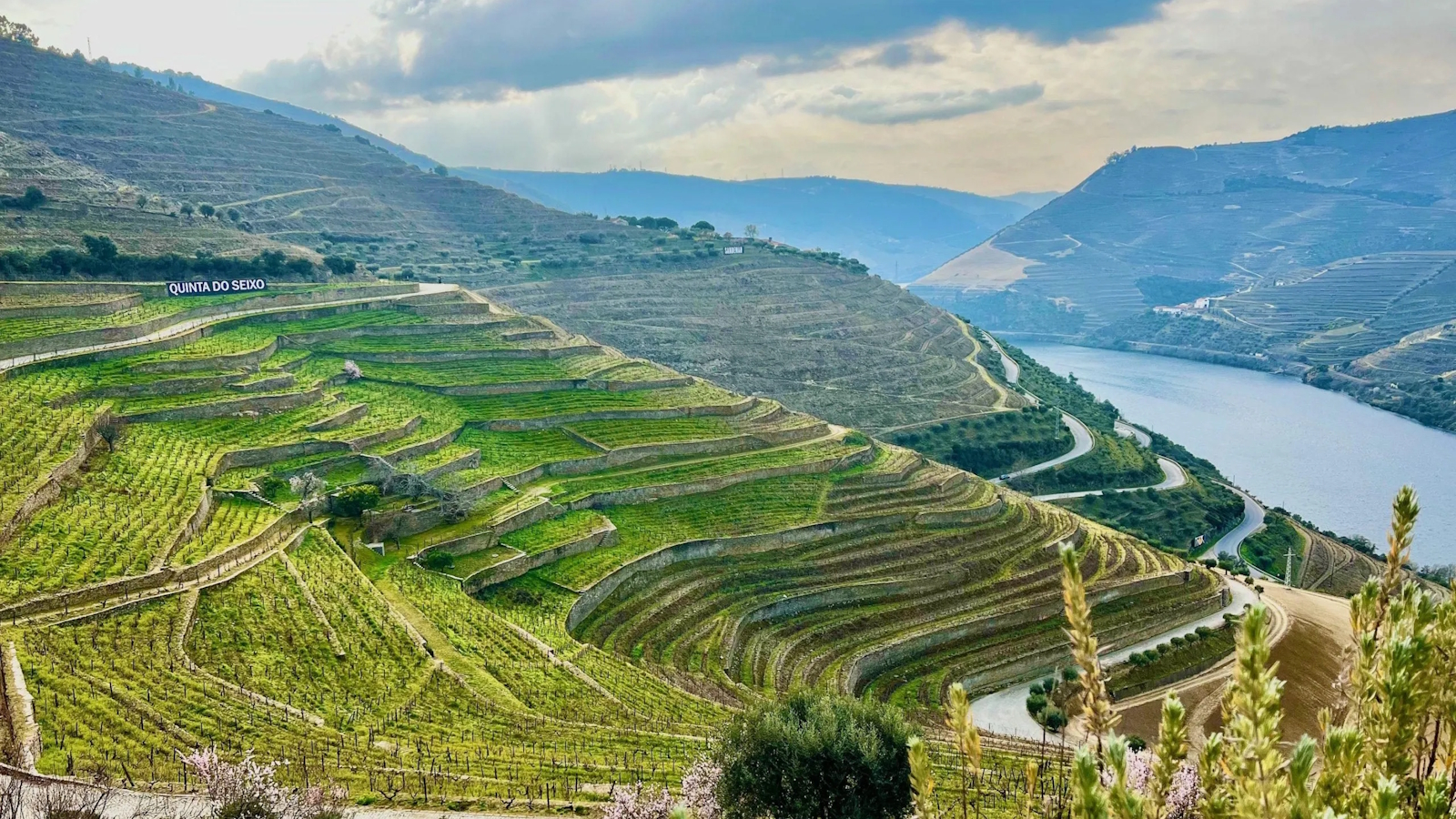
The Douro Valley is the most famous landscape in Portugal and one of the oldest wine regions in the world. The terraced hillsides of the Alto Douro Wine Region stretch for kilometers on both sides of the river, carved by centuries of agriculture into something that looks from the road like a painting that’s been scaled to an impossible size.
The N222 along the south bank is the famous one. The N108 along the north bank is less celebrated and, on some sections, equally good — the two roads offer different perspectives on the same valley, and drivers who only do one are missing half the picture. The Valeira Dam, where the river narrows dramatically between vertical rock walls, is a stop worth building into any Douro itinerary. The viewpoint at São Salvador do Mundo above the dam is considered one of the finest in the entire valley.
Both Blue Strada tours spend significant time in the Douro — the Miata tour arrives from Peneda-Gerês via the N304 and follows the valley east toward Bragança; the motorcycle tour approaches from the south through the Serra da Estrela. The valley looks different from every angle and in every season. In autumn, during the harvest, the vineyards turn gold and the air smells of fermentation. It is a strong argument for October timing.
The Serra da Estrela — Portugal’s Highest Mountain Road
The Serra da Estrela is the highest mountain range in mainland Portugal, and the roads that climb it are among the country’s best-kept driving secrets. The N338 and N339 from Covilhã and Manteigas to Torre — the highest point in mainland Portugal — are a genuine mountain driving experience: proper switchbacks, altitude, and views that extend for extraordinary distances on clear days.
The Serra da Estrela features prominently on the Blue Strada motorcycle tour, which spends two days in this region — arriving from Lousã and continuing into the Douro Valley. The landscape here is more alpine in character than anything else in Portugal: granite plateaus, glacial valleys, and roads that feel genuinely high-altitude in a country most visitors associate with coastal lowlands. It’s a surprise that rewards the motorcycle tour’s more inland routing.
The Trás-os-Montes Region — The Road Less Driven
Trás-os-Montes — literally “behind the mountains” — is the remote northeastern corner of Portugal, separated from the coast by the Douro and its tributaries and characterized by a landscape that changes dramatically from the river valleys to the high plateau. The roads through it carry almost no tourist traffic, pass through villages where the pace of life operates on terms entirely its own, and connect the Douro Valley to the Spanish border through some of the most quietly extraordinary countryside in the Iberian Peninsula.
Bragança, the region’s capital, sits at the northeastern corner — a walled medieval city with a castle that has survived largely intact since the 12th century. The Montesinho Natural Park north of Bragança, on the Spanish border, is one of the wildest and least-visited natural areas in Portugal: remote plateau landscape, traditional villages, and roads that exist primarily because the villages need them rather than because anyone planned a driving route. Which is exactly what makes them interesting.
The Blue Strada Miata tour uses Bragança as the natural end of the Portuguese driving section, arriving via the Tua River valley and Trás-os-Montes from the Douro. The Montesinho Natural Park north of Bragança extends across the border into Spain’s Sanabria region — and the roads that cross that border are every bit as dramatic as the Portuguese side. Northern Spain’s mountain roads deserve their own post. Consider this a preview.
Practical Notes for Drivers in Portugal
Tolls. Unlike Sardinia, Portugal has an extensive toll road network on its main highways (A-roads). Blue Strada routes prioritize national roads (N-roads) which are mostly toll-free — but be aware of the electronic tolling system on some roads that requires a transponder or pre-registration. Rental cars often include toll payment services; confirm before driving.
Road surfaces. The N222, N304, and main national roads are in excellent condition. Rural roads in Trás-os-Montes and Peneda-Gerês can be narrower and rougher. The park roads in Gerês are generally paved but occasionally tight.
Traffic. Portugal’s national roads carry significantly less traffic than equivalent roads in France, Italy, or Spain. The N304 and the mountain roads of Gerês and Trás-os-Montes are notably quiet outside of summer weekends. The N222, particularly the Régua-Pinhão section, can attract weekend drivers and cyclists; early mornings and weekdays are ideal.
Timing. May and October are the optimal months for northern Portugal — moderate temperatures, good light, and either the spring green or the autumn gold of the Douro vineyards. The motorcycle tour runs in the spring; the Miata tour in October. Both seasons have strong arguments.
Fuel. Readily available in towns throughout the route. Remote sections of Gerês and Trás-os-Montes have limited stations — fill up before entering either region.
Coffee. Portugal’s café culture is as good as Italy’s. Every stop, however small, is worth a bica. This is not optional advice.
Sports Cars, Roadsters, Motorcycles — and Two Different Portugals
Blue Strada runs both Miata roadster and motorcycle tours in Portugal, and the routes are deliberately different — not just in vehicle, but in the country they reveal. The Miata tour follows the Atlantic coast, Peneda-Gerês, the Douro Valley, and Trás-os-Montes before crossing into northern Spain. The motorcycle tour goes deeper into central Portugal — through Lousã, the Serra da Estrela, and Colmeal — before arriving in the Douro Valley from the south. A guest who has done one has genuinely not done the other.
That’s by design. Portugal is a small country with an extraordinary variety of landscape packed into it — and the best way to honor that variety is to use it, rather than repeat the same route with a different vehicle. Each Blue Strada motorcycle tour in Portugal also takes a different route, which means even a returning motorcycle guest will see something new.
Drive or Ride Portugal with Blue Strada
Two vehicles — roadster and motorcycle — two routes, one extraordinary country. Both tours include the full Blue Strada experience — local guide, exceptional accommodation, and food that surprises guests who came for the driving.
More Blue Strada Tours
- Tuscany & Umbria Driving Tour The tour that started it all — hill towns, wine roads, and Umbrian mountain passes. October 2026 still has availability.
- Sardinia Driving Tour The SS125 and the Gorropu canyon. Europe’s best kept driving secret.
- Italian & Swiss Alps Driving Tour Four Italian passes, four Swiss passes, and Andermatt. The most driving-focused tour in the fleet.
No Responses