
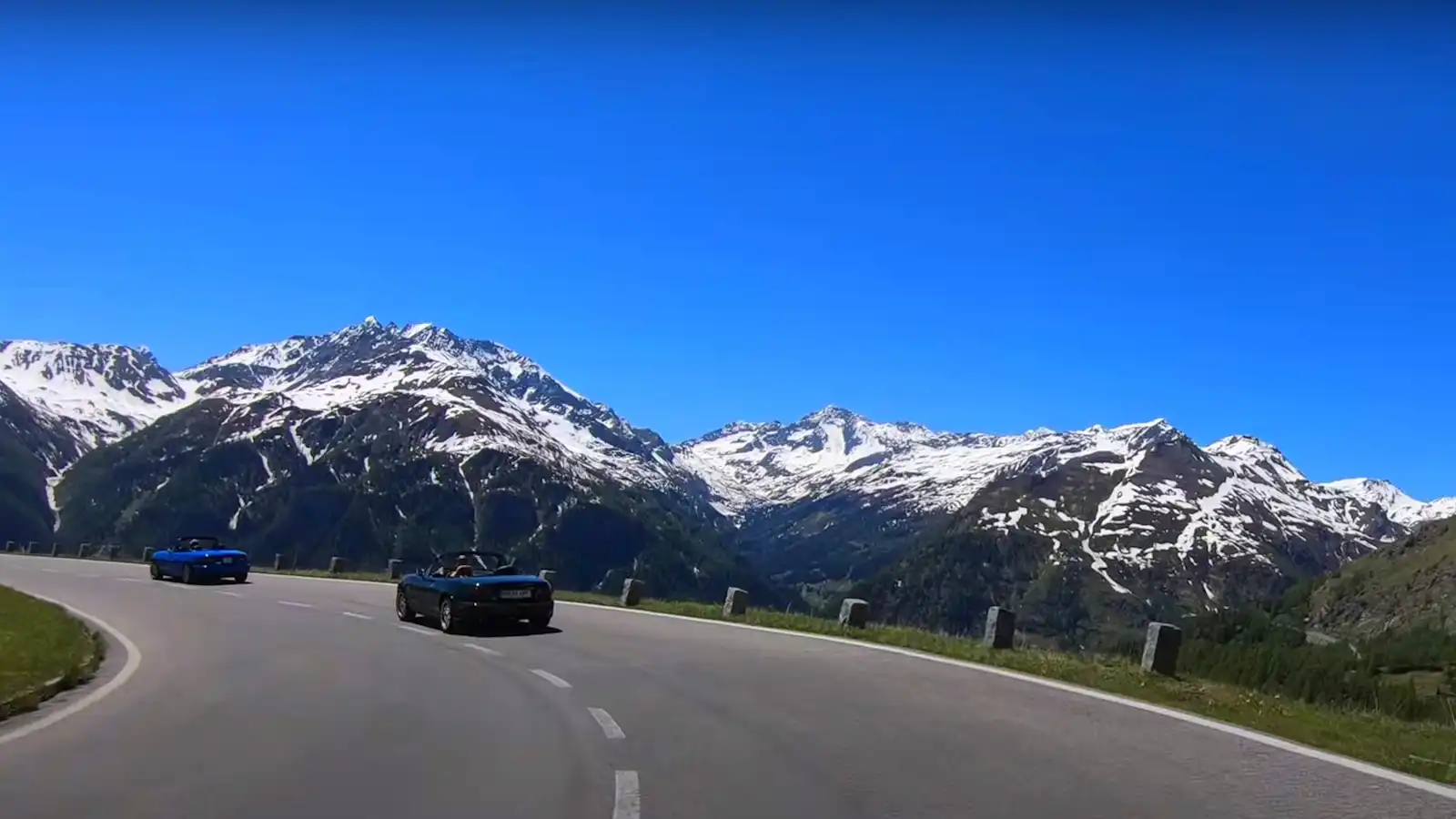
The Road to Andermatt: Five Passes Through the Swiss Alps
Ask a professional driving instructor where to take a student who already knows how to drive and wants to learn how to drive well, and they will often say Switzerland. The passes around Andermatt — the Furka, the Grimsel, the Susten — are widely regarded as the best driving roads in the Alps not because they are the most dramatic or the most famous, but because they prioritize flow over frustration. They are roads that reward skill rather than just enthusiasm, and they do it on surfaces that are consistently excellent and in scenery that is consistently extraordinary.
Five passes converge on Andermatt. Two days to drive them. One town you won’t want to leave.
Every road in this article leads to Andermatt. The Furka arrives from the west. The Grimsel from the north. The Susten from the east. The Gotthard from the south. The Oberalp from the northeast. The small Swiss town at the convergence of five major Alpine passes is not just a convenient overnight stop — it is the reason serious drivers come to Switzerland in the first place, and the reason Blue Strada builds two days here into its Alps tour.
Getting to Andermatt is the point. The roads that lead there are the experience. And almost none of the traffic that crosses the Alps every day shares those roads with you — because the trucks, the vans, and the freight convoys all take the tunnels. The Gotthard Base Tunnel carries millions of tons of goods between Italy and northern Europe every year. The mountain passes above it carry the drivers who came specifically for them.
The Italian Alps have the drama and the legend. The Swiss Alps have the driving. Both are worth experiencing — the companion article on the Italian Alpine passes covers the Dolomites and the Stelvio — but if you have driven both and had to choose one for a week of serious road driving, most experienced Alpine drivers choose Switzerland.
Here is why.
Andermatt — The Hub Everything Radiates From
Any serious Swiss Alpine driving itinerary begins and ends in Andermatt. The town sits at the convergence of five major passes — the Gotthard, the Furka, the Oberalp, the Susten, and the Gotthard Tremola — in the canton of Uri at the geographical heart of the Swiss Alps. It is small, beautiful, and almost entirely oriented around the roads that converge on it.
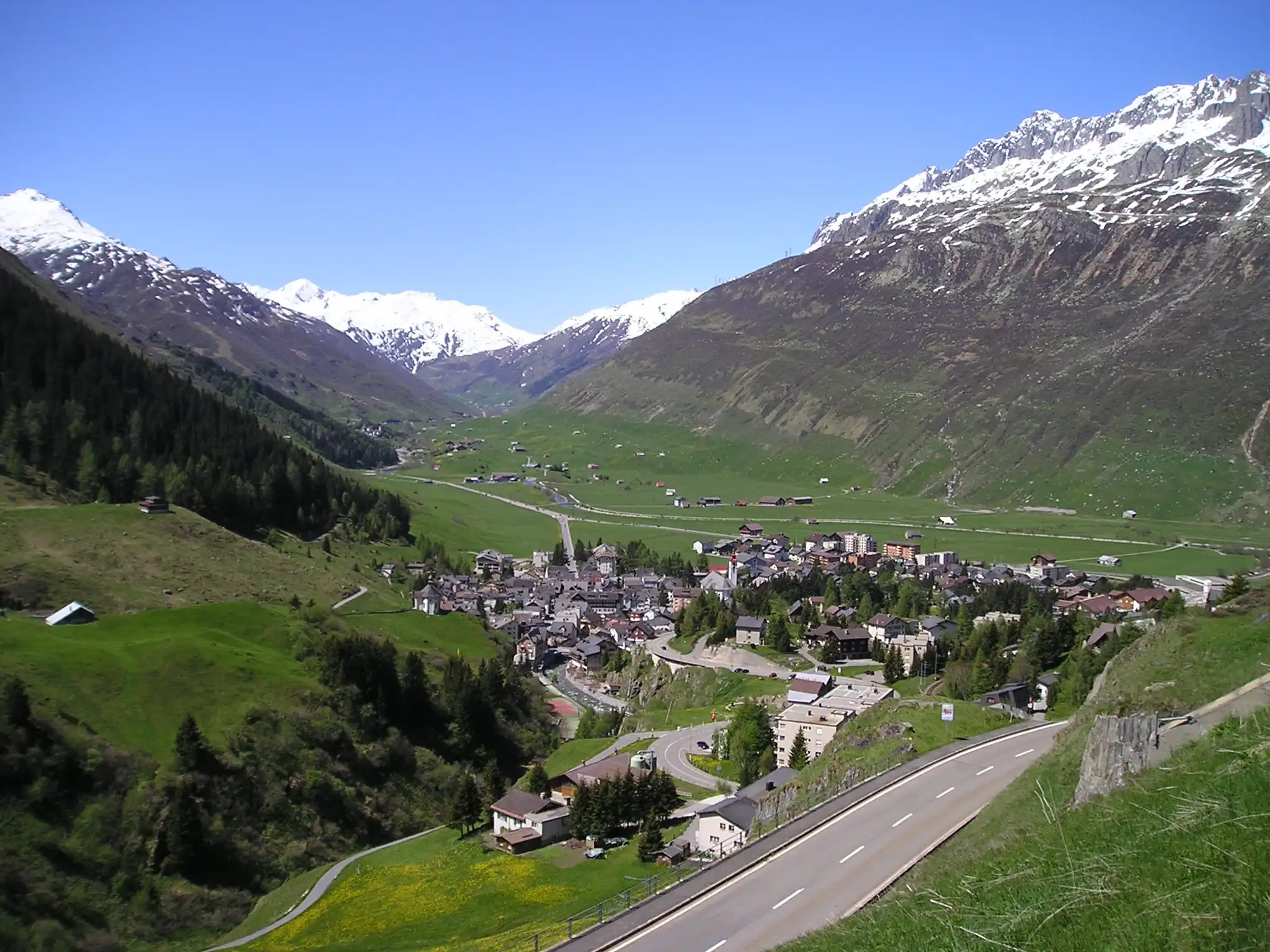
Andermatt, looking west toward Hospental — five Alpine passes converge on this valley. Photo: Lutz Fischer-Lamprecht, CC BY-SA 3.0 via Wikimedia Commons.
A free day in Andermatt, for drivers who choose to spend it on the road rather than walking the village, is effectively an open invitation to sample all of the above. The passes radiate outward and return to the same point, which means every loop brings you back to the same excellent hotel and the same evening discussion about which pass was better. The answer changes depending on the day, the light, and who you ask.
Blue Strada builds a free day into the Alps tour at Andermatt specifically for this reason. It is the right decision, and guests who use it well come back for dinner with strong opinions.
The Big Three — Furka, Grimsel, and Susten
The Furka, Grimsel, and Susten passes form a triangle around the Andermatt area that together constitute what serious Alpine drivers call the Big Three — the most concentrated collection of excellent pass driving anywhere in Switzerland.
The Furka Pass (2,429m) is the most famous of the three, largely due to its appearance in the James Bond film Goldfinger — the Aston Martin DB5 chase sequence was filmed on its slopes above Andermatt. At 2,429 meters, it is one of the highest Swiss Alpine roads, with roomy hairpin bends and stunning views of the Rhône Glacier that make it feel genuinely high-altitude rather than just elevated. The road is technically challenging but not intimidating — blind turns, sharp bends, and gradients of up to 11% that work the tires and demand full attention, but with sightlines and road widths that allow confident driving.
The Grimsel Pass (2,164m) is what driving instructors point to when they want to explain what a great driving road actually is. Unlike the engineering exercise of the Stelvio or the celebrity of the Furka, the Grimsel is roadwork art — sweeping curves through dramatic reservoir scenery, a pass that flows rather than challenges, and the kind of rhythm that makes a driver lose track of distance entirely. The reservoir at the summit — the Grimselsee — is one of the most dramatic pieces of engineering in the Swiss Alps, a dam that holds back a turquoise lake between granite walls at altitude. Compared to the other passes, it is also largely traffic-free. This combination makes it, for many experienced Alpine drivers, the finest driving road of the three.
The Susten Pass (2,260m) is perhaps less famous than Furka but arguably the greatest driving road of the three — wide corners, smooth tarmac, and a panoramic climb to 2,260 meters with glacier views and a perfect grand-touring rhythm. The eastern approach from Wassen is a long, sweeping climb that rewards pace. The western descent toward Innertkirchen passes through dark forests and across stunning stone bridges that make it feel like a different road from the one you climbed. It is one of Switzerland’s finest alpine drives regardless of direction.
The three passes can be linked into a loop from Andermatt — the Oberalp east to connect, then the Grimsel from the north, across to the Furka, and the Susten back to Andermatt. That loop, done in a day at a reasonable pace with stops, is one of the finest single days of road driving available anywhere in Europe.
The St. Gotthard — History and the Tremola
The St. Gotthard Pass (2,106m) has been a major Alpine crossing since the 13th century, and the modern road reflects that history — it is one of the most used and most engineered passes in Switzerland. As a pure driving experience, it sits below the Big Three in terms of flow and excitement. As a piece of history and landscape, it is essential.
The Tremola is what makes the Gotthard unmissable for driving enthusiasts. The old cobblestone road on the southern approach — built in the 1830s — winds up the Ticino side of the pass in a series of tight cobbled hairpins that are entirely unlike anything on the modern road network. It was the main route across the Alps for over a century, used by armies, merchants, and travelers who had no alternative. In a car or on a motorcycle, it is not a road for speed — the cobbles demand a completely different approach, slower and more deliberate. It is a road for understanding what crossing the Alps actually meant before anyone bored a tunnel through them.
The Tremola is on Blue Strada’s Alps tour for exactly this reason — as the final day’s road before returning to Milan, it provides a moment of historical perspective after a week of modern asphalt at altitude. It earns its place on any serious Alpine itinerary.
The Engadin Passes — Flüela, Julier, and Albula
East of Andermatt, the Engadin valley provides a different character of Swiss Alpine driving — broader, more open, with a light quality in the high valley that is distinct from the dramatic shadows of the central passes.
The Flüela Pass (2,383m) connects the Engadin to Davos with a fast, sweeping character — broader and more open than the central Swiss passes, with long sightlines that invite a different driving rhythm. It rewards pace rather than technique, and in a roadster or convertible the exposed summit plateau is an extraordinary place to stop.
The Julier Pass (2,284m) is one of the oldest Alpine crossings in existence — used since Roman times, with Roman columns still standing at the summit. The road is wide by Swiss standards, the gradients forgiving, and the views across the Engadin exceptional. It is a pass where the history and scenery do the work rather than the driving, but that is no criticism.
The Albula Pass (2,315m) is the narrow, technical alternative — a series of tight hairpins through a landscape that shifts from forest to bare rock to snowfield with altitude. Less traveled than the Julier, it rewards drivers who prefer engagement over spectacle, though spectacle is present in abundance regardless.
Why the Swiss Roads Are Different
The road surfaces in Switzerland are maintained to an excellent standard — lanes are generally wider than Italian equivalents, guardrails are consistent, signage is clear, and gradients are carefully managed. Swiss engineering means the switchbacks have good sight lines. This is either the point or missing the point, depending on what you came for.
For drivers who want the adrenaline of negotiating a road that feels genuinely alpine and occasionally precarious, the Italian passes deliver more of that. For drivers who want to actually drive well — to find a rhythm, carry speed through corners, and experience the road as a flowing sequence rather than a series of obstacles — the Swiss passes are superior. The Stelvio is a bucket list experience. The Grimsel is a driving experience. Both are worth having.
The tunnels carry the trucks. The mountain roads carry the drivers. In Switzerland, that means the Swiss passes are as traffic-free as geography allows — the commercial traffic that would otherwise cross the Alps takes the Gotthard tunnel, leaving the Furka, the Grimsel, and the Susten to the people who came specifically for them.
Practical Notes for Swiss Alpine Drivers
Pass opening dates. The Furka and Grimsel typically open in early to mid-June and close in October or November. The Susten opens slightly earlier. Real-time pass status is available from TCS Switzerland — check before departure. Snowfall can close passes overnight at any time above 2,000 meters even in summer.
Traffic. Significantly lighter than the Italian passes on the same day. The Swiss pass network is well-distributed and the tunnels absorb commercial traffic. Weekend mornings on the Furka attract motorcyclists and enthusiast drivers — still manageable compared to the Stelvio on a Saturday.
Road surfaces. Consistently excellent. The Swiss road maintenance standard is notably higher than the Italian equivalent, and the wider lanes mean less stress meeting oncoming traffic on hairpins. The Tremola is the deliberate exception — cobblestone by design, driven accordingly.
Fuel and services. Well-distributed through the valley towns. Summit facilities exist on some passes but are not universal. Andermatt has good facilities and is the natural refueling point for any loop itinerary.
Vignette. Switzerland requires a motorway vignette (toll sticker) for driving on Swiss highways — CHF 40 per year, available at the border. The mountain passes are not highways and do not require the vignette, but any transit on Swiss motorways does. Worth purchasing at the border crossing.
Speed limits. Swiss enforcement of speed limits is consistent and the fines are substantial. The mountain passes have posted limits that are generally sensible for the road — they are not suggestions.
Driving the Swiss Alps with Blue Strada
Blue Strada’s Italian & Swiss Alps tour crosses from Italy into Switzerland via the Stelvio and Umbrail, then covers four Swiss passes to Davos, more Swiss passes including the St. Gotthard to Andermatt, a free day, and the return via the Tremola. The Swiss section — three full days of pass driving centered on Andermatt — is the heart of the tour.
This year’s tour introduces Swift — one of only four Yamamoto Signature Edition MX-5s ever built — on its debut tour. A car conceived around Yamamoto-san’s philosophy of lightness and connection, on the passes that best reward exactly those qualities.
Check the tour page for current dates and availability.
Blue Strada Alps Driving Tours
Three different Alpine itineraries — the Dolomites and Switzerland, the museums and mountain passes, or the French Alps and Verdon Gorge. All starting from Milan.
No Responses