
Eight Passes, Eight Nights: Inside the Italian & Swiss Alps Tour
Eight passes. Eight nights. One free day in Andermatt to do it all again. The Italian & Swiss Alps tour is Blue Strada’s most driving-focused week.
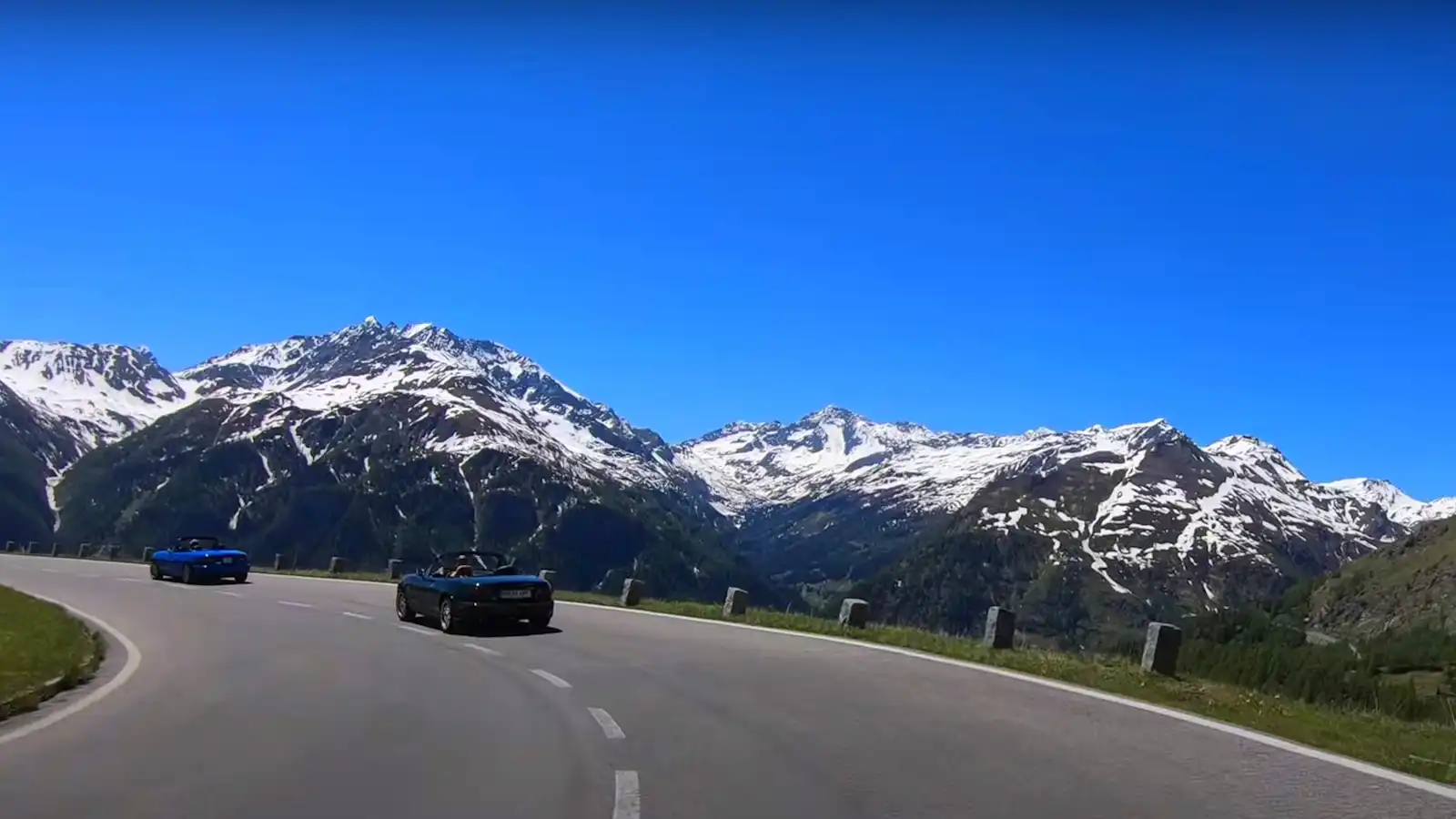
Most Blue Strada guests arrive on the Alps tour expecting great roads. That expectation is met — comfortably. What catches them off guard is the scale of it. You do not drive one great pass on this tour. You do not drive two or three. Over seven touring days, the route crosses the Dolomites, the Stelvio, the Umbrail, four Swiss passes arriving in Davos, more Swiss passes to Andermatt, and the Tremola on the way home. By the end of the week, guests who came as driving enthusiasts — in one of our Miatas or other roadsters — leave as Alpine drivers, which is a genuinely different thing.
This is the tour to book if the roads are the point. Not the only point — the food is exceptional, the properties are carefully chosen, and Andermatt is one of the most beautiful small towns in Switzerland. But on the scale from “hybrid driving and cultural tour” to “we came here to drive,” the Italian & Swiss Alps sits firmly at the driving end. Guests who want maximum pass coverage in a week have found their tour.
The Italian Section — The Dolomites and the Stelvio
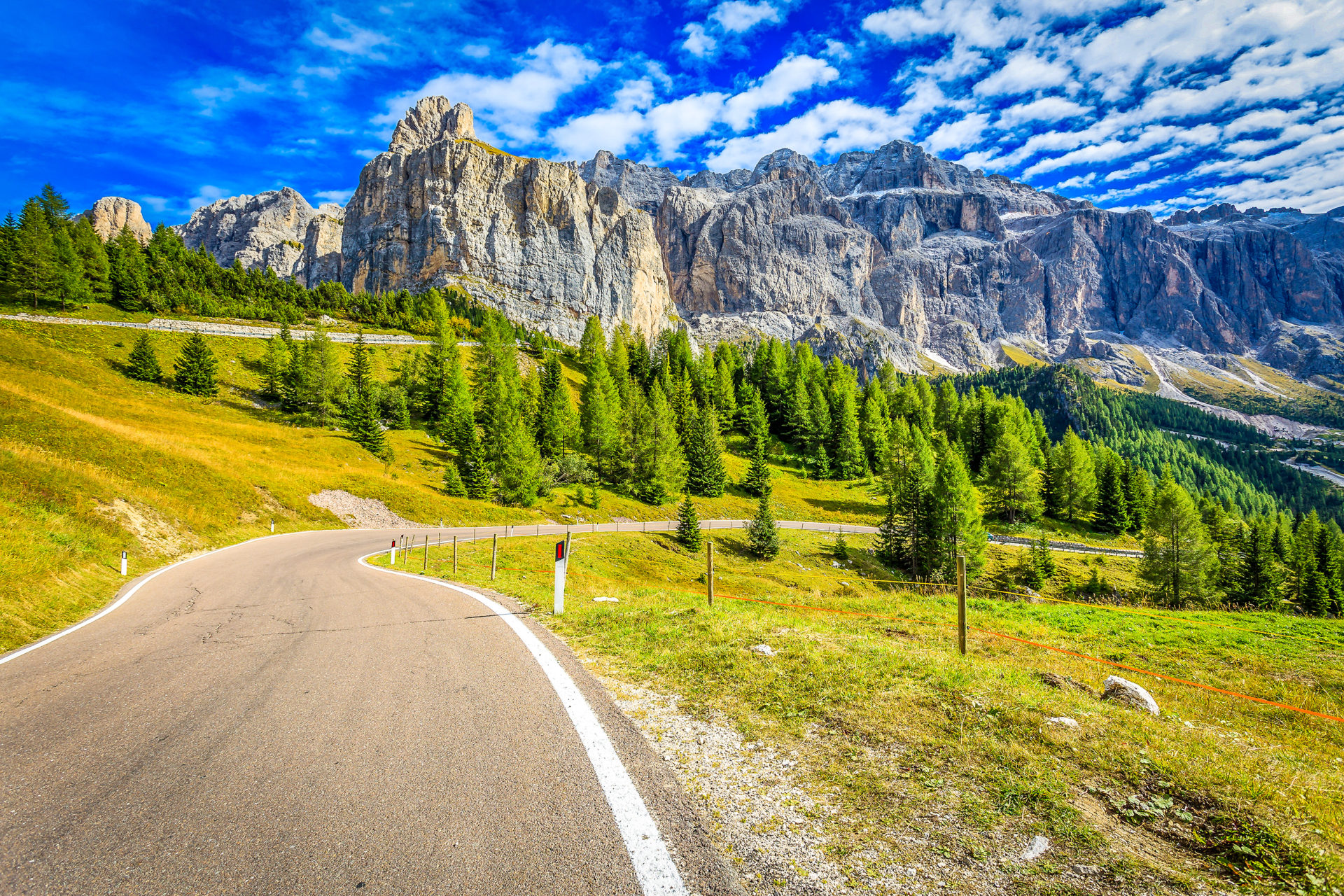
The tour begins in Milan and heads northeast into the Dolomites — a UNESCO World Heritage landscape of pale limestone peaks and mountain passes with a character entirely distinct from anything in Switzerland. The first two days cover four Italian passes through the Fassa Valley, with the Sella Ronda circuit — Passo Sella, Passo Pordoi, Passo Gardena, Passo Campolongo — as the centerpiece. The Dolomites are tighter, steeper, and more dramatic than the Swiss passes that follow. In a Miata, the narrow hairpins and the immediate rock faces on both sides deliver a kind of engaged, technical driving that the Swiss roads — broader, more flowing — don’t replicate. It is the kind of road that reminds you why you chose a sports car over something more sensible.
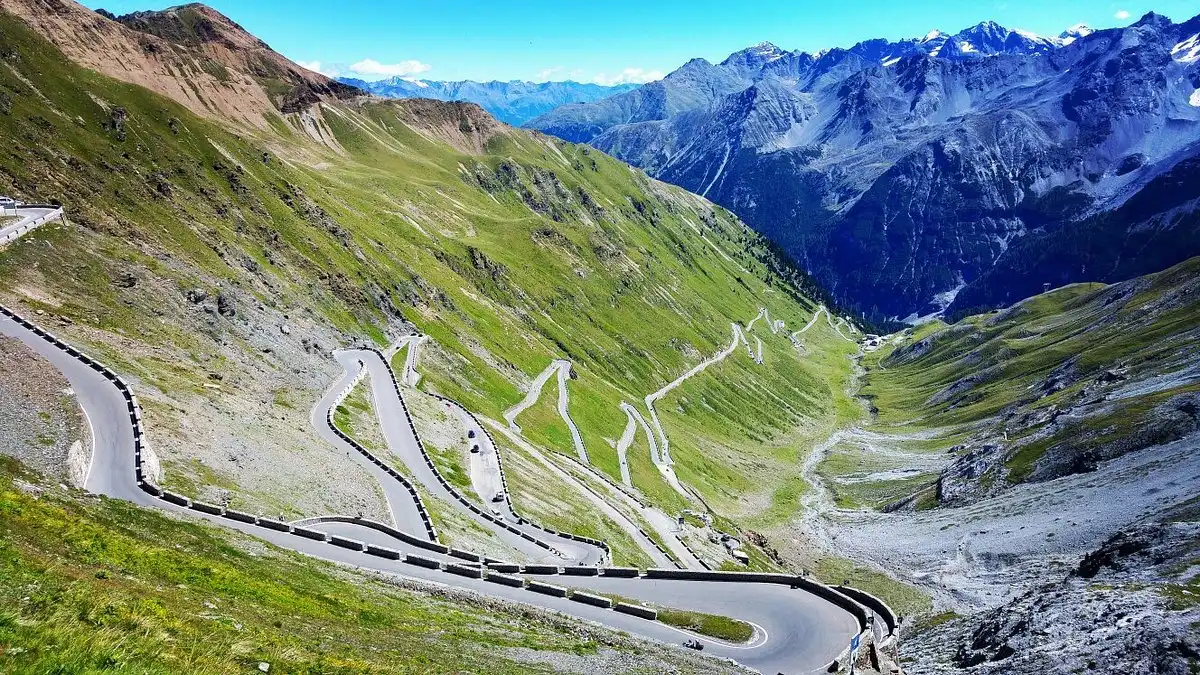
Day three brings the Stelvio. The second-highest paved pass in the Alps, 48 numbered hairpins on the eastern approach, and a reputation that precedes it by decades. The honest advice: drive it early. The Stelvio on a quiet morning — before the tour coaches and the summer weekend traffic — is close to the Top Gear verdict. In a roadster, with the summit above and 48 hairpins below, it earns every word of it. The Stelvio at noon in July is a patience exercise. Blue Strada builds the Stelvio into a day that allows for early departure, and the difference is considerable.
The Umbrail Pass branches from the Stelvio summit toward the Swiss border — Switzerland’s highest fully paved pass, less traveled than its neighbor, and in some ways more satisfying. The transition from Italy to Switzerland happens almost immediately in the road surface, the signage, and the guardrail frequency. The Umbrail is the natural segue between the Italian and Swiss sections of the tour, and it earns its place on the route.
For a deeper look at the Italian passes — what makes each one distinctive and which corners the guidebooks miss — see Above the Tree Line: A Driver’s Guide to the Italian Alpine Passes.
The Swiss Section — Four Passes to Davos, Then Andermatt
Crossing the Umbrail into Switzerland, the tour covers four major Swiss passes arriving in Davos — the Flüela, the Julier, and the Albula among them — before continuing to Andermatt via more Swiss passes including the St. Gotthard. The Swiss passes have a different character from the Italian ones: broader, better-surfaced, with sightlines that allow a different kind of driving rhythm. Where the Dolomites reward technique, the Swiss passes reward pace — and a convertible with the top down at 2,400 meters rewards both. The Furka, Grimsel, and Susten — the Big Three around Andermatt — are widely regarded by Alpine driving veterans as the finest driving roads in Switzerland, and the free day in Andermatt exists specifically so guests can experience them properly rather than passing through.
The free day is one of the best decisions Blue Strada makes on this tour. Andermatt sits at the convergence of five major passes. A free day there, for any guest who chooses to use it on the road, is an open invitation to loop the Furka, Grimsel, and Susten — a circuit that experienced Alpine drivers describe as the finest single day of pass driving available anywhere in Europe — and in a convertible, with the peaks visible in every direction, the finest single day of open-air driving full stop. Guests who use the day to walk the village and recover are equally well-served. Both groups arrive at dinner with strong opinions.
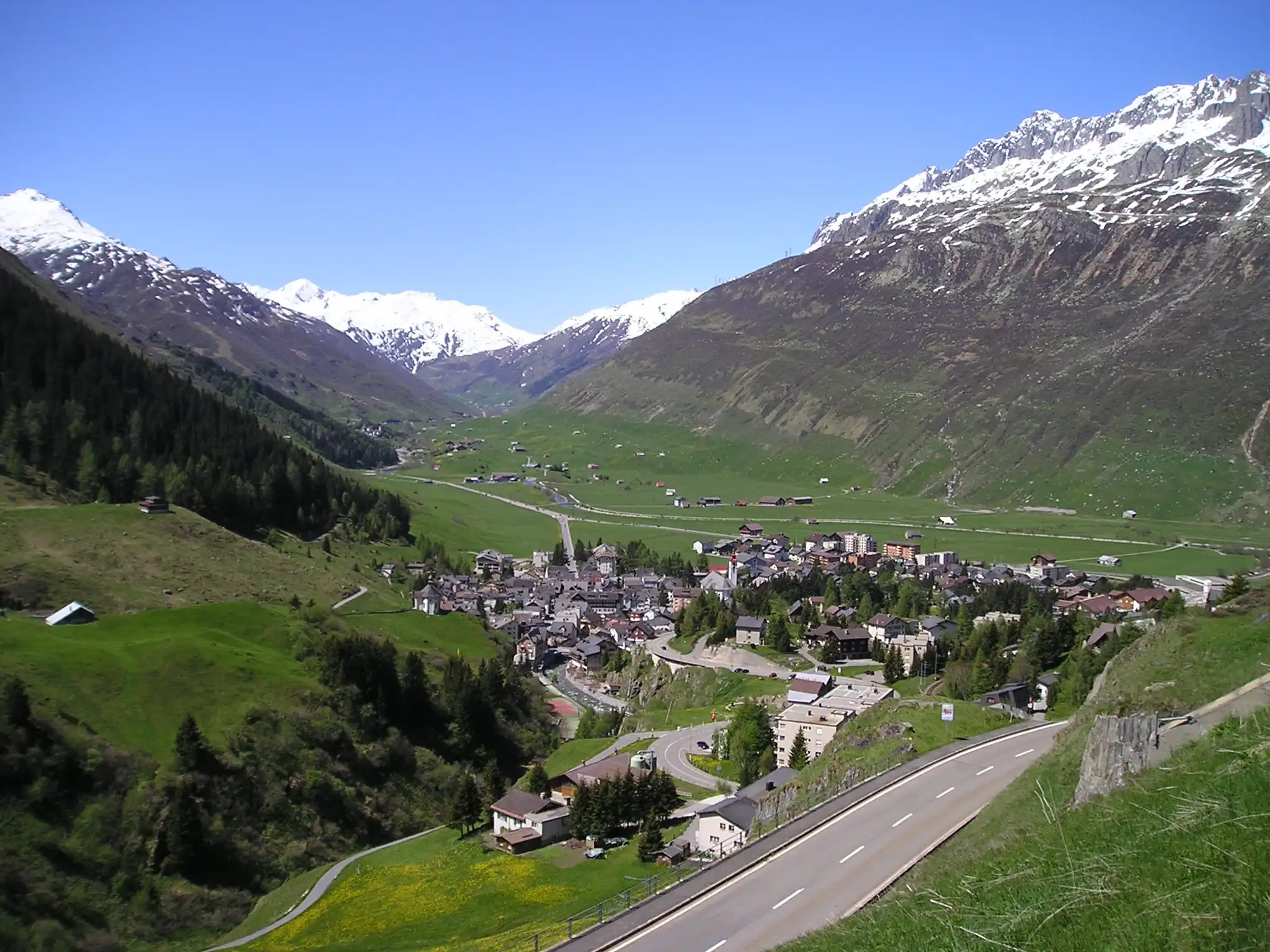
Andermatt — five Alpine passes converge on this valley. Photo: Lutz Fischer-Lamprecht, CC BY-SA 3.0 via Wikimedia Commons.
The return to Milan follows the Tremola — the old cobblestone road on the southern approach to the St. Gotthard, built in the 1830s, a series of tight cobbled hairpins that is entirely unlike any modern road. It is not a road for speed. It is a road for understanding what crossing the Alps meant before anyone bored a tunnel through them. After a week of asphalt at altitude, it is the right way to come down — slow enough that you notice everything, in whatever car you drove here, before handing the keys back.
The full story of the Swiss passes — the Furka and its James Bond credentials, the Grimsel and why driving instructors recommend it, the Susten and its glacier views — is in The Road to Andermatt: Five Passes Through the Swiss Alps.
What the Tour Actually Feels Like
The Italian & Swiss Alps is the most driving-focused tour in the Blue Strada fleet — which means the balance between road time and cultural stops sits further toward the road than on Tuscany or Portugal. That is a feature for the guests who book it, not a limitation. Most days begin with a pass or a sequence of passes in the morning, a lunch stop in a mountain village or a valley town, more passes in the afternoon, and arrival at the next property in the late afternoon. The format — described in detail here — applies on this tour as on all others: sport group and touring group, radios, running order optimized by midweek.
The accommodation quality is Blue Strada standard throughout — properties chosen for character as much as comfort, in locations that place the next day’s passes within reach. The food in Switzerland is excellent in a different way from the food in Italy, and the tour crosses back into Italy for the final day’s return, which means the farewell dinner is appropriately Italian.
Book the Italian & Swiss Alps Driving Tour
Eight passes, eight nights, 1,500 kilometers. The Dolomites, the Stelvio, Andermatt, and the Tremola — Milan to Milan. Check the tour page for current dates and availability.
View the Italian & Swiss Alps Driving Tour →
No Responses