
Sardinia: Europe’s Best Kept Driving Secret
- Home
- /
- BLOG
- /
- ROADS & DESTINATIONS
- /
- SARDINIA: EUROPE’S BEST KEPT DRIVING SECRET
Sardinia is not the first place most driving enthusiasts think of when planning a European road trip. The Alps get the hairpins, Tuscany gets the scenery, Portugal gets the credit for hidden gems. Sardinia gets overlooked — which is, for the people who actually drive it, a significant competitive advantage.
The island has no autostradas. No tolls. Minimal truck traffic on the roads that matter. Surface quality that regularly shocks visitors expecting something rougher. And a concentration of genuinely extraordinary driving roads that is, mile for mile, difficult to match anywhere in the Mediterranean. The driving community has quietly known about the SS125 for years. The rest of the island is still largely to themselves.
It was, in part, the desire to take our Miatas to Sardinia that led Blue Strada to establish its own fleet. Running the tours on borrowed cars had opened up Tuscany and Umbria — but getting to Sardinia meant owning the cars outright, and being free to take them wherever the roads led. The island did not disappoint.
The SS125 Orientale Sarda — A Strong Case for the World’s Best Driving Road
There are many great roads in the world. Then there is the SS125 Orientale Sarda. That is the consistent verdict of drivers who have spent careers chasing great roads across multiple continents and weren’t expecting Sardinia to be where they found the benchmark.
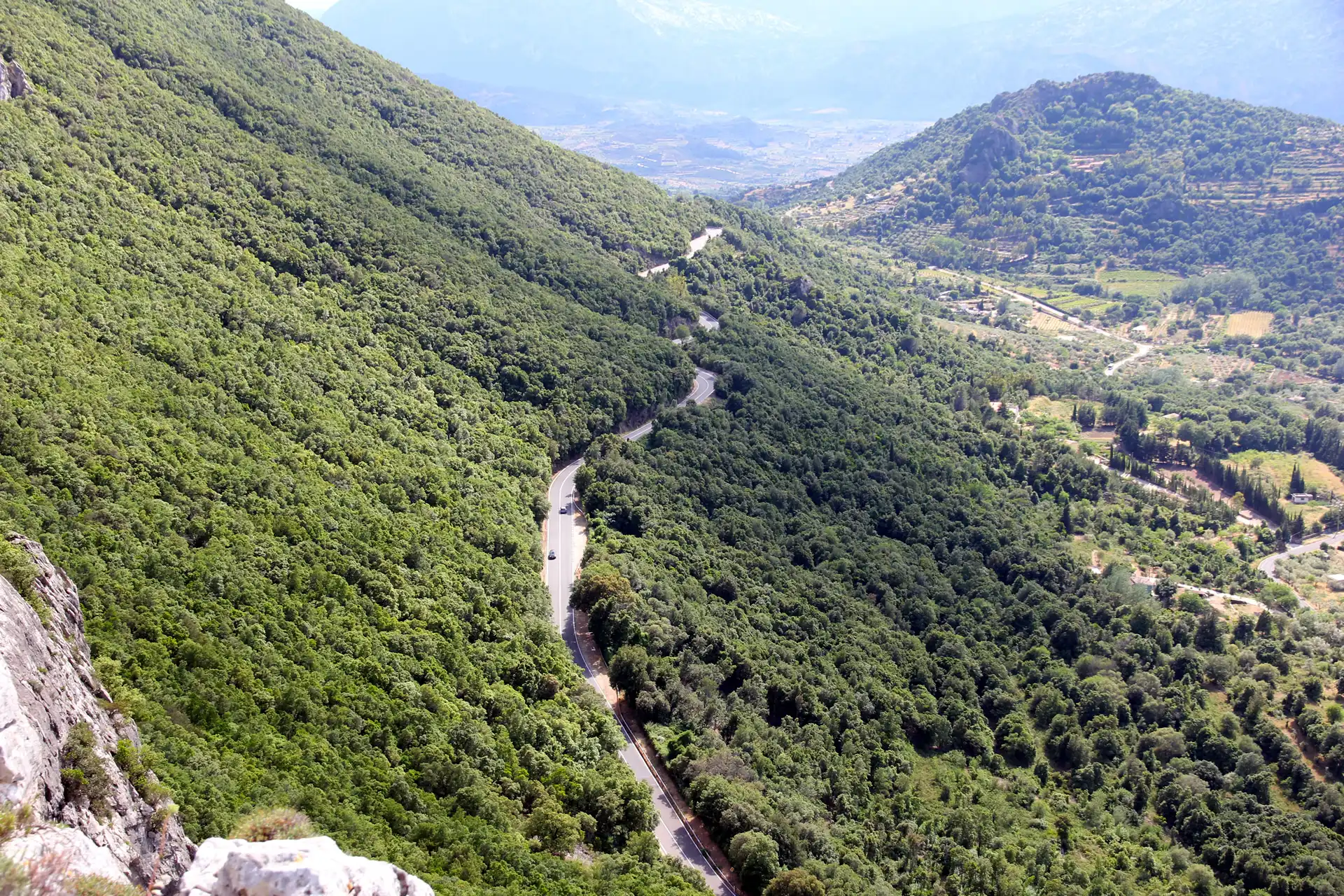
The SS125 runs the entire eastern length of the island — 354 km from Cagliari in the south to Palau in the north. The section the driving community talks about, and the section Blue Strada’s Sardinia tour focuses on, is the central stretch: the 50-kilometer run from Baunei through Urzulei to Dorgali, where the road climbs into the Supramonte massif through a succession of mountain passes — Genna Arramene, Genna Coggina, Ghenna ‘e Silana — on near-perfect asphalt with minimal traffic and views that change character with every kilometer.
At Ghenna ‘e Silana, roughly the midpoint of this stretch, there is a bar and a roadman’s house that appears suddenly after tens of kilometers of pure mountain landscape. It is a good place to stop, breathe, and look at what surrounds you: the green limestone Supramonte of Urzulei on one side, an expanse of rock reaching toward the Orgosolo mountains on the other. Then get back in the car, because the road to Dorgali is waiting.
South of the Supramonte section, between Dorgali and Arbatax, the road shifts character again: tighter, more rhythmic, with the Gulf of Orosei appearing through gaps in the rock on the descent toward the coast. Drivers who have done this section on a clear afternoon, with the light coming off the water between the limestone walls, tend to run out of superlatives fairly quickly.
On a Blue Strada Sardinia tour, guests spend two full days in this canyon and coastal road region. Most describe it as the best sustained driving of any European tour they’ve taken. That includes guests who have also driven Tuscany, Portugal, and the Alps.
The Gorropu Canyon — Italy’s Deepest Gorge, Accessed from the Road
The SS125 brings you within reach of the Gola di Gorropu — Italy’s deepest canyon and one of the most dramatic natural landscapes in the entire Mediterranean. Its limestone walls reach 500 meters in height; in places, the gorge narrows to just four meters across. It is the kind of geological spectacle that makes you feel appropriately small.
The approach from the SS125 is itself part of the experience — the road cuts through the heart of the Supramonte, past imposing limestone formations and through a landscape that shifts between forest and bare rock before the canyon entrance appears. The canyon is accessible on foot from the road. A morning’s driving on the SS125 combined with an afternoon descent into the Gorropu is the kind of day that takes a while to process over dinner.
The nearby village of Cala Gonone, on the Gulf of Orosei coast below Dorgali, is the natural base for this section of the island — a small resort town with access to some of the most extraordinary coves in the Mediterranean, including Cala Goloritzé, accessible only by sea or a serious hike, and the Grotta del Bue Marino sea caves. The combination of canyon road driving and coastal access makes the Dorgali–Baunei area uniquely complete as a touring destination.
The Barbagia Interior — The Island Within the Island
Inland from the SS125, the Barbagia is the ancient mountainous heartland of Sardinia — isolated, culturally distinct, and almost entirely off the tourist circuit. The roads through the Gennargentu massif and the interior villages pass through landscape that feels genuinely remote: herds of sheep in the road, the occasional wild pig, mountain villages where the pace of life operates on entirely different terms from the coastal resorts.
The village of Orgosolo is the most famous destination in the interior — known across Italy for its political murals that cover virtually every building surface, a tradition begun in 1969 and still actively maintained. The road from the coast to Orgosolo is excellent; the murals themselves reward the detour even for those who came primarily to drive.
The Su Gologone hotel and spring, near Oliena on the route from the SS125 into the Barbagia, is one of the most celebrated stopping points on the entire island — a spring that produces 300 liters of water per second from the base of a limestone massif, and a hotel that has been serving traditional Sardinian food since 1960. Arriving there after a morning on the SS125 is a reliable highlight of the eastern tour.
The SS198 — Alghero to Arbatax
The SS198 runs from the western coast near Alghero across the island’s interior to Arbatax on the eastern coast — a full crossing that takes in dramatically different landscape on either side of the central highlands. The western approach descends through rugged terrain before the road opens into broader valleys; the eastern section tightens again as it approaches Arbatax and the Gulf of Torrei.
It’s a road that rarely appears on driving enthusiasts’ lists, largely because most visitors to Sardinia stick to either the east or west coast and don’t make the crossing. That’s the opportunity: a long, quiet, varied route through the interior that connects two of the island’s most rewarding coastlines, with almost no tourist traffic on the inland sections.
The Southwest Coast — Mining Roads and Pan di Zucchero
The southwestern corner of Sardinia is the least-visited part of the island and, for a driver in a sports car, one of the most rewarding. The road from Fontanamare through Nebida to Masua — roughly eight kilometers of coastal cliff road — is the kind of route that doesn’t appear on most driving itineraries because most driving itineraries are written by people who stuck to the east coast. A full week on the island rarely allows time to reach it — the west-to-east crossing and the canyon roads consume the days — which makes it an argument for a return trip.
After passing Nebida, the Pan di Zucchero appears: a 133-meter limestone sea stack rising from the water just offshore, named for its resemblance to the Sugarloaf Mountain in Rio de Janeiro. It appears suddenly as the road rounds a corner above the cliff — one of those moments where you stop the car not because you planned to, but because not stopping seems impossible. At sunset, the light on the limestone turns the stack deep shades of gold and orange.
The surrounding area was once one of Italy’s most productive mining districts — lead, silver, and zinc extracted from the cliffs for centuries, first by the Phoenicians, then the Romans, then through to the 20th century. The infrastructure built to service those mines — the roads, the tunnels carved into cliff faces, the clifftop loading facilities — now provides a landscape of industrial archaeology that makes the driving genuinely unusual. The Porto Flavia mine, cut 600 meters into the cliff to allow ore to be loaded directly onto ships below, is visible from the road above Masua.
The SP71 Costa del Sud — The South’s Best Coastal Road
The SP71 along the Costa del Sud in the island’s southwest is officially designated a Strada Panoramica — panoramic road — and the designation is, for once, accurate. The route runs between Chia and Teulada through a succession of coves, white sand beaches, and Spanish watchtowers built during the centuries of Spanish occupation of Sardinia. The towers appear at intervals along the coast, solitary and weathered, and serve as a navigational landmark as much as a historical one.
The beaches along the SP71 are among the finest in the Mediterranean — Tuerredda, with its turquoise water set against green scrub and white sand, is regularly cited among the best beaches in Europe. The road that passes them is narrow, winding, and largely empty outside of July and August. In May or October, you drive it with the top down and encounter virtually no other traffic. Like the southwest mining roads, it sits in a corner of the island that a one-week tour rarely reaches — accommodations in this area are sparse, which tends to route itineraries toward the more developed east and north coasts.
The North — Costa Smeralda and the Emerald Coast
The northeastern coast offers a different character entirely: the famous Costa Smeralda and its approaches, where the road runs along cliffs above water so vividly turquoise that the Emerald Coast name feels like understatement. The SS133 and SS125 through this area carry coastal panoramas that rank among the most visually striking driving in Italy — and in the shoulder seasons, traffic is light enough to enjoy them properly.
The north also holds some of the island’s best-preserved nuraghe — the ancient stone towers built by the pre-Roman Nuragic civilization between 1900 and 900 BC. Sardinia has over 7,000 of them, more than any other ancient structure type in the world, and encountering them from the road — suddenly appearing in fields and on ridgelines — is one of those distinctly Sardinian experiences that has no equivalent elsewhere in Europe.
Practical Notes for Drivers
No autostradas, no tolls. Sardinia has no autostradas and no toll roads. The island’s main arteries are superstradas and national roads (SS), with the interesting driving on the secondary SP roads and the SS125 itself. Budget more time than the distances suggest — the good roads are not the fast ones.
Traffic on the SS125. The Supramonte section is largely truck-free — heavy vehicles use the inland SS389 instead. Outside of July and August, traffic on the key driving sections is minimal. In peak summer the coastal sections can get busy, but the mountain roads remain manageable.
Wildlife on the road. Sardinia’s interior roads cross open grazing land. Sheep, cattle, and wild pigs in the road are a genuine occurrence, particularly on mountain roads and at dawn and dusk. This is not a figure of speech. Stay alert, especially after dark.
Road surfaces. The SS125 through the Supramonte is in excellent condition. The interior mountain roads vary — generally well-maintained but with rough patches after winter. The southwest coastal roads are good. Rural tracks and farm roads are unpaved; a low-slung car is not the right tool for those.
Timing. April through June and mid-September through October are the optimal months — warm, uncrowded, and with the island still green from winter rain. July and August bring heat, coastal traffic, and tourist density that works against a driving itinerary. The SS125 in May, with the Supramonte still lush, is the version to experience.
Fuel. Fill up in towns. The Supramonte section of the SS125 has one gas station in roughly 50 kilometers of mountain road. Running low before Ghenna ‘e Silana is an avoidable problem with a small amount of planning.
Sardinia for Miatas and Motorcycles
Blue Strada runs both Miata and motorcycle tours on the island, and the roads reward both equally — in different ways. The Miata has specific advantages on the SS125 and the SS198: low enough to feel the road quality directly under you, narrow enough to use the full lane through the tight Supramonte hairpins, and with enough cornering feedback to make the rhythm of the road genuinely communicative rather than just fast. In a Miata, the SS125 between Dorgali and Arbatax is not something you complete. It’s something you experience.
The motorcycle has its own rewards: the sound of an engine note against limestone canyon walls, the ability to stop anywhere without the geometry of a car to manage, and the particular freedom of two wheels on mountain roads above the sea that no four-wheeled experience quite replicates.
Blue Strada was running motorcycle tours to Sardinia years before the Miata tours existed — the island’s roads were already well-known to the team. But when the Miata program launched in 2019, Sardinia was out of reach. The borrowed cars that made the Tuscany tour possible came with strict limits on kilometers and distance from home base. Getting the Miatas to Sardinia meant owning them outright. It was one of the reasons Claudio established Blue Strada’s own fleet in 2023 — and one of the first things the fleet made possible. The full story of how that came about is in The Tour That Started It All.
Drive or Ride Sardinia with us
Our Sardinia tours cover the SS125, the Gorropu canyon approach, and the best of the island’s coastal and mountain roads — guided by someone who knows which corners the maps miss.
More Blue Strada Italian Tours
- Tuscany & Umbria The tour that started it all — hill towns, wine roads, and the Umbrian mountain passes. 2026 and 2027 dates available.
- Italian & Swiss Alps 1,500 km through the high passes and lakeside villages of the Alps. A different Italy entirely. 2027 dates available.
Sardinia is not the first place most driving enthusiasts think of when planning a European road trip. The Alps get the hairpins, Tuscany gets the scenery, Portugal gets the credit for hidden gems. Sardinia gets overlooked — which is, for the sports car and motorcycle enthusiasts who actually drive it, a significant competitive advantage.
The island has no autostradas. No tolls. Minimal truck traffic on the roads that matter. Surface quality that regularly shocks visitors expecting something rougher. And a concentration of genuinely extraordinary driving roads that is, mile for mile, difficult to match anywhere in the Mediterranean. The driving community has quietly known about the SS125 for years. The rest of the island is still largely to themselves.
It was, in part, the desire to take our Miatas to Sardinia that led Blue Strada to establish its own fleet. Running the tours on borrowed cars had opened up Tuscany and Umbria — but getting to Sardinia meant owning the cars outright, and being free to take them wherever the roads led. The island did not disappoint.
The SS125 Orientale Sarda — A Strong Case for the World’s Best Driving Road
There are many great roads in the world. Then there is the SS125 Orientale Sarda. That is the consistent verdict of drivers who have spent careers chasing great roads across multiple continents and weren’t expecting Sardinia to be where they found the benchmark.
The SS125 runs the entire eastern length of the island — 354 km from Cagliari in the south to Palau in the north. The section the driving community talks about, and the section Blue Strada’s Sardinia tour focuses on, is the central stretch: the 50-kilometer run from Baunei through Urzulei to Dorgali, where the road climbs into the Supramonte massif through a succession of mountain passes — Genna Arramene, Genna Coggina, Ghenna ‘e Silana — on near-perfect asphalt with minimal traffic and views that change character with every kilometer.
At Ghenna ‘e Silana, roughly the midpoint of this stretch, there is a bar and a roadman’s house that appears suddenly after tens of kilometers of pure mountain landscape. It is a good place to stop, breathe, and look at what surrounds you: the green limestone Supramonte of Urzulei on one side, an expanse of rock reaching toward the Orgosolo mountains on the other. Then get back in the car, because the road to Dorgali is waiting.
Portugal’s N222 also has a claim to the title — Avis named it the best driving road in the world. We’ll let you settle the debate for yourself, ideally after driving both. See The Best Driving Roads in Portugal.
South of the Supramonte section, between Dorgali and Arbatax, the road shifts character again: tighter, more rhythmic, with the Gulf of Orosei appearing through gaps in the rock on the descent toward the coast. Drivers who have done this section on a clear afternoon, with the light coming off the water between the limestone walls, tend to run out of superlatives fairly quickly.
On a Blue Strada Sardinia tour, guests spend two full days in this canyon and coastal road region. Most describe it as the best sustained driving of any European tour they’ve taken. That includes guests who have also driven Tuscany, Portugal, and the Alps.
The Gorropu Canyon — Italy’s Deepest Gorge, Accessed from the Road
The SS125 brings you within reach of the Gola di Gorropu — Italy’s deepest canyon and one of the most dramatic natural landscapes in the entire Mediterranean. Its limestone walls reach 500 meters in height; in places, the gorge narrows to just four meters across. It is the kind of geological spectacle that makes you feel appropriately small.
The approach from the SS125 is itself part of the experience — the road cuts through the heart of the Supramonte, past imposing limestone formations and through a landscape that shifts between forest and bare rock before the canyon entrance appears. The canyon is accessible on foot from the road. A morning’s driving on the SS125 combined with an afternoon descent into the Gorropu is the kind of day that takes a while to process over dinner.
The nearby village of Cala Gonone, on the Gulf of Orosei coast below Dorgali, is the natural base for this section of the island — a small resort town with access to some of the most extraordinary coves in the Mediterranean, including Cala Goloritzé, accessible only by sea or a serious hike, and the Grotta del Bue Marino sea caves. The combination of canyon road driving and coastal access makes the Dorgali–Baunei area uniquely complete as a touring destination.
The Barbagia Interior — The Island Within the Island
Inland from the SS125, the Barbagia is the ancient mountainous heartland of Sardinia — isolated, culturally distinct, and almost entirely off the tourist circuit. The roads through the Gennargentu massif and the interior villages pass through landscape that feels genuinely remote: herds of sheep in the road, the occasional wild pig, mountain villages where the pace of life operates on entirely different terms from the coastal resorts.
The village of Orgosolo is the most famous destination in the interior — known across Italy for its political murals that cover virtually every building surface, a tradition begun in 1969 and still actively maintained. The road from the coast to Orgosolo is excellent; the murals themselves reward the detour even for those who came primarily to drive.
The Su Gologone hotel and spring, near Oliena on the route from the SS125 into the Barbagia, is one of the most celebrated stopping points on the entire island — a spring that produces 300 liters of water per second from the base of a limestone massif, and a hotel that has been serving traditional Sardinian food since 1960. Arriving there after a morning on the SS125 is a reliable highlight of the eastern tour.
The SS198 — Alghero to Arbatax
The SS198 runs from the western coast near Alghero across the island’s interior to Arbatax on the eastern coast — a full crossing that takes in dramatically different landscape on either side of the central highlands. The western approach descends through rugged terrain before the road opens into broader valleys; the eastern section tightens again as it approaches Arbatax and the Gulf of Torrei.
It’s a road that rarely appears on driving enthusiasts’ lists, largely because most visitors to Sardinia stick to either the east or west coast and don’t make the crossing. That’s the opportunity: a long, quiet, varied route through the interior that connects two of the island’s most rewarding coastlines, with almost no tourist traffic on the inland sections.
The Southwest Coast — Mining Roads and Pan di Zucchero
The southwestern corner of Sardinia is the least-visited part of the island and, for a driver in a sports car, one of the most rewarding. The road from Fontanamare through Nebida to Masua — roughly eight kilometers of coastal cliff road — is the kind of route that doesn’t appear on most driving itineraries because most driving itineraries are written by people who stuck to the east coast. A full week on the island rarely allows time to reach it — the west-to-east crossing and the canyon roads consume the days — which makes it an argument for a return trip.
After passing Nebida, the Pan di Zucchero appears: a 133-meter limestone sea stack rising from the water just offshore, named for its resemblance to the Sugarloaf Mountain in Rio de Janeiro. It appears suddenly as the road rounds a corner above the cliff — one of those moments where you stop the car not because you planned to, but because not stopping seems impossible. At sunset, the light on the limestone turns the stack deep shades of gold and orange.
The surrounding area was once one of Italy’s most productive mining districts — lead, silver, and zinc extracted from the cliffs for centuries, first by the Phoenicians, then the Romans, then through to the 20th century. The infrastructure built to service those mines — the roads, the tunnels carved into cliff faces, the clifftop loading facilities — now provides a landscape of industrial archaeology that makes the driving genuinely unusual. The Porto Flavia mine, cut 600 meters into the cliff to allow ore to be loaded directly onto ships below, is visible from the road above Masua.
The SP71 Costa del Sud — The South’s Best Coastal Road
The SP71 along the Costa del Sud in the island’s southwest is officially designated a Strada Panoramica — panoramic road — and the designation is, for once, accurate. The route runs between Chia and Teulada through a succession of coves, white sand beaches, and Spanish watchtowers built during the centuries of Spanish occupation of Sardinia. The towers appear at intervals along the coast, solitary and weathered, and serve as a navigational landmark as much as a historical one.
The beaches along the SP71 are among the finest in the Mediterranean — Tuerredda, with its turquoise water set against green scrub and white sand, is regularly cited among the best beaches in Europe. The road that passes them is narrow, winding, and largely empty outside of July and August. In May or October, you drive it with the top down and encounter virtually no other traffic. Like the southwest mining roads, it sits in a corner of the island that a one-week tour rarely reaches — accommodations in this area are sparse, which tends to route itineraries toward the more developed east and north coasts.
The North — Costa Smeralda and the Emerald Coast
The northeastern coast offers a different character entirely: the famous Costa Smeralda and its approaches, where the road runs along cliffs above water so vividly turquoise that the Emerald Coast name feels like understatement. The SS133 and SS125 through this area carry coastal panoramas that rank among the most visually striking driving in Italy — and in the shoulder seasons, traffic is light enough to enjoy them properly.
The north also holds some of the island’s best-preserved nuraghe — the ancient stone towers built by the pre-Roman Nuragic civilization between 1900 and 900 BC. Sardinia has over 7,000 of them, more than any other ancient structure type in the world, and encountering them from the road — suddenly appearing in fields and on ridgelines — is one of those distinctly Sardinian experiences that has no equivalent elsewhere in Europe.
Practical Notes for Drivers
No autostradas, no tolls. Sardinia has no autostradas and no toll roads. The island’s main arteries are superstradas and national roads (SS), with the interesting driving on the secondary SP roads and the SS125 itself. Budget more time than the distances suggest — the good roads are not the fast ones.
Traffic on the SS125. The Supramonte section is largely truck-free — heavy vehicles use the inland SS389 instead. Outside of July and August, traffic on the key driving sections is minimal. In peak summer the coastal sections can get busy, but the mountain roads remain manageable.
Wildlife on the road. Sardinia’s interior roads cross open grazing land. Sheep, cattle, and wild pigs in the road are a genuine occurrence, particularly on mountain roads and at dawn and dusk. This is not a figure of speech. Stay alert, especially after dark.
Road surfaces. The SS125 through the Supramonte is in excellent condition. The interior mountain roads vary — generally well-maintained but with rough patches after winter. The southwest coastal roads are good. Rural tracks and farm roads are unpaved; a low-slung car is not the right tool for those.
Timing. April through June and mid-September through October are the optimal months — warm, uncrowded, and with the island still green from winter rain. July and August bring heat, coastal traffic, and tourist density that works against a driving itinerary. The SS125 in May, with the Supramonte still lush, is the version to experience.
Fuel. Fill up in towns. The Supramonte section of the SS125 has one gas station in roughly 50 kilometers of mountain road. Running low before Ghenna ‘e Silana is an avoidable problem with a small amount of planning.
Sardinia for Miatas and Motorcycles
Blue Strada runs both Miata and motorcycle tours on the island, and the roads reward both equally — in different ways. A low-slung convertible or roadster has specific advantages on the SS125 and the SS198: low enough to feel the road quality directly under you, narrow enough to use the full lane through the tight Supramonte hairpins, and with enough cornering feedback to make the rhythm of the road genuinely communicative rather than just fast. In a Miata or any open-top sports car, the SS125 between Dorgali and Arbatax is not something you complete. It’s something you experience.
The motorcycle has its own rewards: the sound of an engine note against limestone canyon walls, the ability to stop anywhere without the geometry of a car to manage, and the particular freedom of two wheels on mountain roads above the sea that no four-wheeled experience quite replicates.
Blue Strada was running motorcycle tours to Sardinia years before the Miata tours existed — the island’s roads were already well-known to the team. But when the Miata program launched in 2019, Sardinia was out of reach. The borrowed cars that made the Tuscany tour possible came with strict limits on kilometers and distance from home base. Getting the Miatas to Sardinia meant owning them outright. It was one of the reasons Claudio established Blue Strada’s own fleet in 2023 — and one of the first things the fleet made possible. The full story of how that came about is in The Tour That Started It All.
Drive or Ride Sardinia with us
Our Sardinia tours cover the SS125, the Gorropu canyon approach, and the best of the island’s coastal and mountain roads — guided by someone who knows which corners the maps miss.
More Blue Strada Italian Tours
- Tuscany & Umbria Driving Tour The tour that started it all — hill towns, wine roads, and the Umbrian mountain passes. 2026 and 2027 dates available.
- Italian & Swiss Alps Driving Tour 1,500 km through the high passes and lakeside villages of the Alps. A different Italy entirely. 2027 dates available.
No Responses