
The Best Driving Roads in Tuscany (And Why Driving Enthusiasts Keep Coming Back)
- Home
- /
- BLOG
- /
- ROADS & DESTINATIONS
- /
- THE BEST DRIVING ROADS IN TUSCANY (AND WHY DRIVING ENTHUSIASTS KEEP COMING BACK)
Most people experience Tuscany through a tour bus window or from the terrace of a hill town restaurant. There is nothing wrong with either of those things. But there is a third option, available to anyone willing to show up with a sports car, an open calendar, and a tolerance for getting slightly lost on unmarked farm roads.
Tuscany has been a driving destination since before driving was a leisure activity. The roads that connect its medieval towns were built by people navigating the contours of a landscape — following ridgelines, descending valley floors, climbing through vineyards — long before anyone thought to make them straight. The result is a road network that rewards the driver who slows down, looks for the secondary route, and doesn’t feel compelled to arrive anywhere quickly.
If you want to know the full story of how this route came to be — and why it has never run the same way twice — read The Tour That Started It All.
Here are the roads worth knowing.
The Val d’Orcia — Tuscany’s Most Famous Landscape
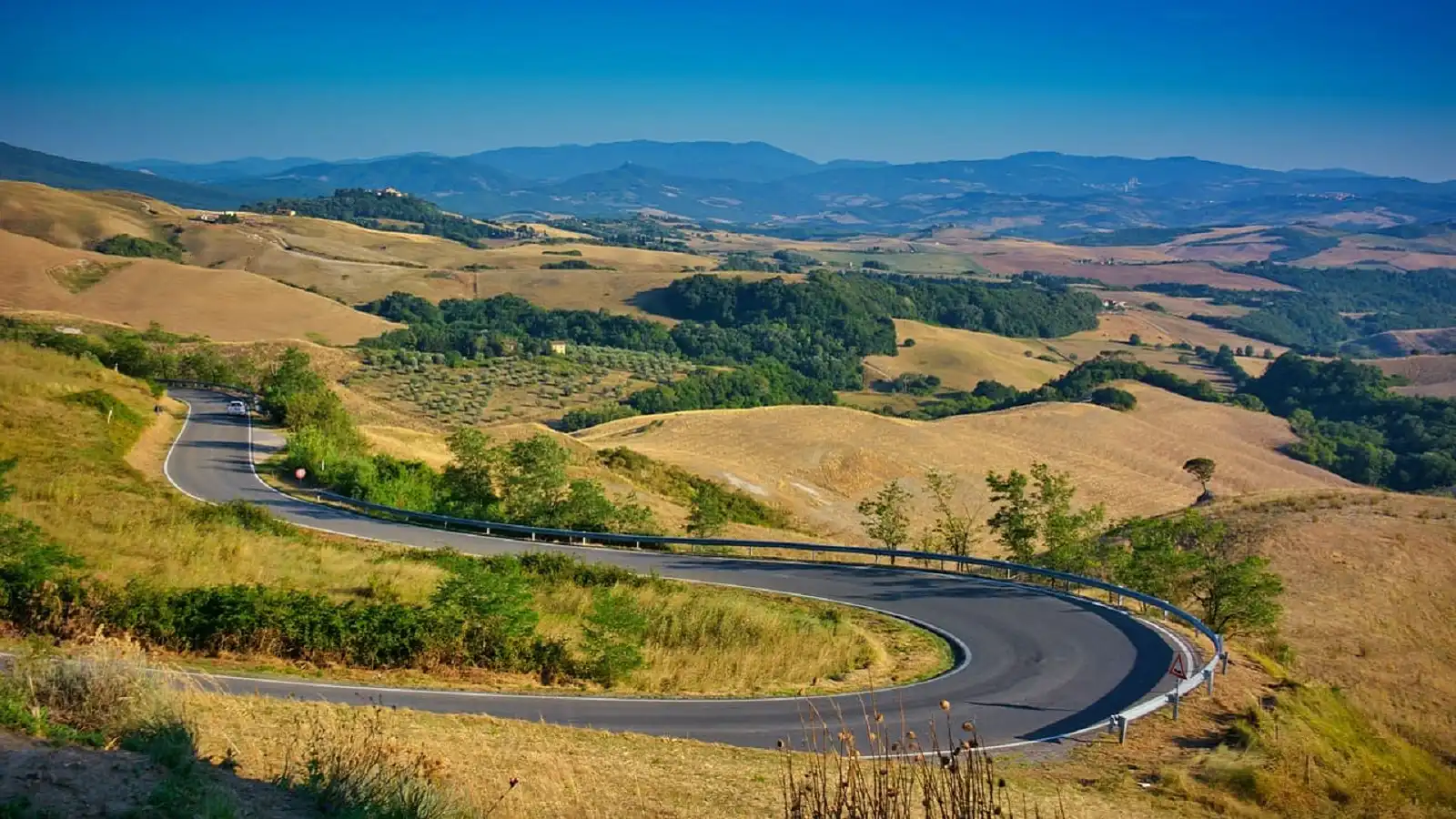
South of Siena, the Val d’Orcia is the Tuscany of postcards and cinema: rolling clay hills, solitary cypress trees on ridgelines, stone farmhouses in wide valleys. The SP146 between San Quirico d’Orcia and Montepulciano is the centerpiece — a road that passes through the famous farmhouse of Podere Belvedere (a filming location for Gladiator), the cypress-lined approach to La Foce estate with its iconic S-curve, and a succession of viewpoints that stop you regularly whether you intend to stop or not.
The towns along the SP146 are all worth stopping for: Pienza, a UNESCO Renaissance ideal city built to the vision of a 15th-century pope; Montepulciano, hilltop and dramatic, with Vino Nobile to match the altitude; Monticchiello, small, fortified, and largely overlooked by the main tourist routes. Plan a full day rather than an afternoon. Things get especially extraordinary at dusk, as the trees cast long shadows across the valley and the light turns the hills deep shades of ochre.
The Crete Senesi — The Lunar Side of Tuscany
Fewer visitors go south-east of Siena into the Crete Senesi, which is exactly why it’s worth going. This is a landscape of pale clay hills with minimal vegetation — sparse, almost otherworldly, changing character completely with the quality of the light. The road from Buonconvento via the SP451 toward Asciano, passing the Abbazia di Monte Oliveto Maggiore, is narrow with low traffic, the kind of road you can stop on without inconveniencing anyone.
The detour to Baccoleno — one of the most photographed farmhouses in the region, with a long cypress avenue leading to the building — requires navigating on unmarked roads, which is half the appeal. This is not a tourist circuit. It’s a landscape to get properly lost in, which in a Miata on a clear morning is exactly the right kind of lost to be.
The SR222 Chiantigiana — The Wine Road
The SR222 runs through the heart of Chianti Classico wine country between Florence and Siena. For driving purposes, the interesting section is the southern half, approaching Siena through the vineyards: Greve, Panzano, Radda, Castellina. Medieval stone villages appearing between estate wine gates and cypress avenues, at intervals that suit a driver who wants to stop but not too often.
Florence itself is a magnificent city and a genuinely poor place to drive — a tangle of ZTL restricted zones, tourist buses, and narrow medieval streets that serve nobody in a sports car. The SR222 north of Greve is fine; Florence is for walking. The southern Chiantigiana, toward Siena, is where the driving earns its reputation.
The Chiantigiana was also part of the original Mille Miglia route — the legendary open-road endurance race that ran from 1927 to 1957 and helped define Ferrari, Maserati, and Alfa Romeo on the world stage. The road has the bones of a serious driving route underneath its wine-country scenery.
The Strade Bianche — the white gravel roads that give cycling’s most dramatic one-day race its name — run through this region too. In a Miata, they’re manageable at moderate pace and extraordinary to look at, though the surface keeps honest anyone tempted to treat them like asphalt.
Montalcino and Brunello Country
The hilltop town of Montalcino anchors the Brunello wine region, and the roads that approach it — through Val d’Orcia villages, across low ridges through vineyards — are among the most satisfying in Tuscany for the simple reason that they have no particular reason to be busy. The Brunello di Montalcino is reason enough to stop. The road there is reason enough to take the long way.
The Approach to San Gimignano
San Gimignano is best approached from the south — a climbing road through Vernaccia wine country that delivers the town’s famous medieval towers as a horizon surprise before you arrive. The town itself is a ZTL zone and gets crowded in high season; the roads around it are excellent and largely ignored by the tourist traffic that concentrates in the car parks below the walls. Arrive by road, park outside, walk in.
The Road to San Galgano
The ruined Gothic abbey of San Galgano — a 13th-century church open to the sky, its roof long collapsed — sits in a valley west of Siena reached by secondary roads that carry almost no traffic. The approach through Murlo, across a ridge, and down into the valley is unexpectedly engaging: narrow, unhurried, and quiet in a way that the main Tuscan tourist routes simply aren’t. Worth combining with the Crete Senesi into a full day’s driving loop that most visitors never find.
The Apennine Crossing into Umbria
The mountain roads that cross from Tuscany into Umbria are a different kind of driving entirely. Where the Tuscan roads reward patience and scenery, the Apennine passes reward commitment — hairpin sequences, long ridge-top sections, genuine altitude. The National Park of the Monti Sibillini on the Umbrian side is where the road to Castelluccio di Norcia climbs to a high plateau at nearly 1,500 meters, ringed by peaks, exposed and extraordinary. It is one of the most dramatic pieces of driving in central Italy and almost entirely unknown outside Italy itself.
Most Tuscany driving itineraries stop at the regional border. The ones that cross into Umbria are the better ones.
Practical Notes for Drivers
ZTL zones — Zona a Traffico Limitato restrictions apply in the historic centers of most Tuscan towns. Cameras enforce them automatically; fines arrive weeks later. Siena, San Gimignano, Pienza, Orvieto — park outside the walls and walk. The roads approaching these towns are excellent; the streets inside them are for pedestrians.
Timing — May and October are the optimal months. The light is exceptional, temperatures are ideal for open-top driving, and the tourist and campervan density that affects July and August is largely absent. October also brings the grape harvest, which adds energy to the wine country roads that’s worth experiencing.
The secondary roads — the most interesting driving in Tuscany is never on the main routes. The SP and local roads are where the region reveals itself. They’re generally well-maintained, though rural roads can have rough patches, and the Strade Bianche are gravel — treat them accordingly.
Fuel — fill up in towns. Rural stations can have unpredictable opening hours, and running low on a ridge road between vineyards is an avoidable problem.
Driving Tuscany in a Miata
All of the above — the Val d’Orcia, the Crete Senesi, the Chianti roads, the approach to San Galgano, the Umbrian crossing, Castelluccio — is the territory covered by our Tuscany & Umbria tour. Seven days of driving, 1,500 kilometers, a Miata roadster for every day, and a route built by someone who was born in Tuscany and has spent years working out which roads the guidebooks miss and has spent years working out which roads the guidebooks miss.
The October 2026 dates still have availability, and 2027 introduces an extended tour departing from Milan with an extra day of driving.
Drive These Roads in a Miata
Our Tuscany & Umbria tour covers 1,500 kilometers of the roads above — with a local guide who’s been driving them his entire life.
More Italian Miata Tours
- Italian & Swiss Alps Driving Tour The high passes and lakeside villages of the Alps — a different Italy entirely. 2027 dates available.
- Sardinia Driving Tour Island roads that Claudio ranks among the finest he’s driven anywhere. 2026 and 2027 dates open.
Most people experience Tuscany through a tour bus window or from the terrace of a hill town restaurant. There is nothing wrong with either of those things. But there is a third option, available to anyone willing to show up with a sports car, an open calendar, and a tolerance for getting slightly lost on unmarked farm roads.
Tuscany has been a driving destination since before driving was a leisure activity. The roads that connect its medieval towns were built by people navigating the contours of a landscape — following ridgelines, descending valley floors, climbing through vineyards — long before anyone thought to make them straight. The result is a road network that rewards the driver who slows down, looks for the secondary route, and doesn’t feel compelled to arrive anywhere quickly.
If you want to know the full story of how this route came to be — and why it has never run the same way twice — read The Tour That Started It All.
Here are the roads worth knowing.
The Val d’Orcia — Tuscany’s Most Famous Landscape
South of Siena, the Val d’Orcia is the Tuscany of postcards and cinema: rolling clay hills, solitary cypress trees on ridgelines, stone farmhouses in wide valleys. The SP146 between San Quirico d’Orcia and Montepulciano is the centerpiece — a road that passes through the famous farmhouse of Podere Belvedere (a filming location for Gladiator), the cypress-lined approach to La Foce estate with its iconic S-curve, and a succession of viewpoints that stop you regularly whether you intend to stop or not.
The towns along the SP146 are all worth stopping for: Pienza, a UNESCO Renaissance ideal city built to the vision of a 15th-century pope; Montepulciano, hilltop and dramatic, with Vino Nobile to match the altitude; Monticchiello, small, fortified, and largely overlooked by the main tourist routes. Plan a full day rather than an afternoon. Things get especially extraordinary at dusk, as the trees cast long shadows across the valley and the light turns the hills deep shades of ochre.
The Crete Senesi — The Lunar Side of Tuscany
Fewer visitors go south-east of Siena into the Crete Senesi, which is exactly why it’s worth going. This is a landscape of pale clay hills with minimal vegetation — sparse, almost otherworldly, changing character completely with the quality of the light. The road from Buonconvento via the SP451 toward Asciano, passing the Abbazia di Monte Oliveto Maggiore, is narrow with low traffic, the kind of road you can stop on without inconveniencing anyone.
The detour to Baccoleno — one of the most photographed farmhouses in the region, with a long cypress avenue leading to the building — requires navigating on unmarked roads, which is half the appeal. This is not a tourist circuit. It’s a landscape to get properly lost in, which in a Miata on a clear morning is exactly the right kind of lost to be.
The SR222 Chiantigiana — The Wine Road
The SR222 runs through the heart of Chianti Classico wine country between Florence and Siena. For driving purposes, the interesting section is the southern half, approaching Siena through the vineyards: Greve, Panzano, Radda, Castellina. Medieval stone villages appearing between estate wine gates and cypress avenues, at intervals that suit a driver who wants to stop but not too often.
Florence itself is a magnificent city and a genuinely poor place to drive — a tangle of ZTL restricted zones, tourist buses, and narrow medieval streets that serve nobody in a sports car. The SR222 north of Greve is fine; Florence is for walking. The southern Chiantigiana, toward Siena, is where the driving earns its reputation.
The Chiantigiana was also part of the original Mille Miglia route — the legendary open-road endurance race that ran from 1927 to 1957 and helped define Ferrari, Maserati, and Alfa Romeo on the world stage. The road has the bones of a serious driving route underneath its wine-country scenery.
The Strade Bianche — the white gravel roads that give cycling’s most dramatic one-day race its name — run through this region too. In a Miata, they’re manageable at moderate pace and extraordinary to look at, though the surface keeps honest anyone tempted to treat them like asphalt.
Montalcino and Brunello Country
The hilltop town of Montalcino anchors the Brunello wine region, and the roads that approach it — through Val d’Orcia villages, across low ridges through vineyards — are among the most satisfying in Tuscany for the simple reason that they have no particular reason to be busy. The Brunello di Montalcino is reason enough to stop. The road there is reason enough to take the long way.
The Approach to San Gimignano
San Gimignano is best approached from the south — a climbing road through Vernaccia wine country that delivers the town’s famous medieval towers as a horizon surprise before you arrive. The town itself is a ZTL zone and gets crowded in high season; the roads around it are excellent and largely ignored by the tourist traffic that concentrates in the car parks below the walls. Arrive by road, park outside, walk in.
The Road to San Galgano
The ruined Gothic abbey of San Galgano — a 13th-century church open to the sky, its roof long collapsed — sits in a valley west of Siena reached by secondary roads that carry almost no traffic. The approach through Murlo, across a ridge, and down into the valley is unexpectedly engaging: narrow, unhurried, and quiet in a way that the main Tuscan tourist routes simply aren’t. Worth combining with the Crete Senesi into a full day’s driving loop that most visitors never find.
The Apennine Crossing into Umbria
The mountain roads that cross from Tuscany into Umbria are a different kind of driving entirely. Where the Tuscan roads reward patience and scenery, the Apennine passes reward commitment — hairpin sequences, long ridge-top sections, genuine altitude. The National Park of the Monti Sibillini on the Umbrian side is where the road to Castelluccio di Norcia climbs to a high plateau at nearly 1,500 meters, ringed by peaks, exposed and extraordinary. It is one of the most dramatic pieces of driving in central Italy and almost entirely unknown outside Italy itself.
Most Tuscany driving itineraries stop at the regional border. The ones that cross into Umbria are the better ones.
Practical Notes for Drivers
ZTL zones — Zona a Traffico Limitato restrictions apply in the historic centers of most Tuscan towns. Cameras enforce them automatically; fines arrive weeks later. Siena, San Gimignano, Pienza, Orvieto — park outside the walls and walk. The roads approaching these towns are excellent; the streets inside them are for pedestrians.
Timing — May and October are the optimal months. The light is exceptional, temperatures are ideal for open-top driving, and the tourist and campervan density that affects July and August is largely absent. October also brings the grape harvest, which adds energy to the wine country roads that’s worth experiencing.
The secondary roads — the most interesting driving in Tuscany is never on the main routes. The SP and local roads are where the region reveals itself. They’re generally well-maintained, though rural roads can have rough patches, and the Strade Bianche are gravel — treat them accordingly.
Fuel — fill up in towns. Rural stations can have unpredictable opening hours, and running low on a ridge road between vineyards is an avoidable problem.
Driving Tuscany in a Miata
All of the above — the Val d’Orcia, the Crete Senesi, the Chianti roads, the approach to San Galgano, the Umbrian crossing, Castelluccio — is the territory covered by our Tuscany & Umbria tour. Seven days of driving (eight in 2027), 1,500 kilometers, a Miata roadster for every day, and a route built by someone who was born in Tuscany and has spent years working out which roads the guidebooks miss and has spent years working out which roads the guidebooks miss.
The October 2026 dates still have availability, and 2027 introduces an extended tour with an extra day of driving.
Drive These Roads in a Miata
Our Tuscany & Umbria tour covers 1,500 kilometers of the roads above — with a local guide who’s been driving them his entire life.
More Italian Miata Tours
- Italian & Swiss Alps The high passes and lakeside villages of the Alps — a different Italy entirely. 2027 dates available.
- Sardinia Island roads that Claudio ranks among the finest he’s driven anywhere. 2026 and 2027 dates open.
No Responses